What are dark matter and dark energy?
Nguồn và giấy phép
- Tên bài
- What are dark matter and dark energy?
- Tác giả
- Akash Kundu
- Tạp chí
- Scholarly Review Journal, 2025
- DOI
- 10.70121/001c.137973
- Giấy phép
- CC BY 4.0
Đã chuyển định dạng từ bản gốc; nội dung không thay đổi.
Xem bản gốc
What are dark matter and dark energy?
By Akash Kundu
AUTHOR BIO
My name is Akash Kundu, and I am a 17 year old 11th grader pursuing computer science. I am based out of Kolkata, West Bengal ,India. I have an affinity for physics, maths and topics regarding the universe, and I intend to study astrophysics in the future. I can play both violin and piano as I learnt them under ABRSM, and I am an avid fan of football and often play football with my friends. I speak 4 languages: English, Bengali, Hindi and French, and I love solving math problems.
ABSTRACT
The universe comprises everything, be it humans, animals, stars, planets, dark matter, dark energy and a lot more. When we look up at the night sky, we see stars. When we observe them closely with powerful telescopes, we can see that they exhaust their resources and release light energy into the vast universe. But what are the dark matter and dark energy that make up most of our universe? This research paper is a literature review and will cover both the topics of dark matter and dark energy alongside the Hubble constant and Einstein's cosmological constant, both of which will help in understanding the properties and how dark energy plays a role in the future of our universe.
Keywords: dark matter, gravity, dark energy, galaxies, Hubble constant, repulsive force, accelerated expansion of the universe

DARK MATTER, GENERALLY
Everything we visibly see around us—that is, humans, plants, animals, stars and others—are just a combined 4.6% of our universe while 24% is composed of dark matter and 71.4% is dark energy (NASA, 2018). Dark matter was coined by Fritz Zwicky in 1933, while dark energy was discovered by Adam Reiss and his team of scientists in 1998. Dark matter and dark energy are not only invisible to our eyes, but also we can't detect them, so it's only possible to notice their effects, which scientists have taken note of over the years.
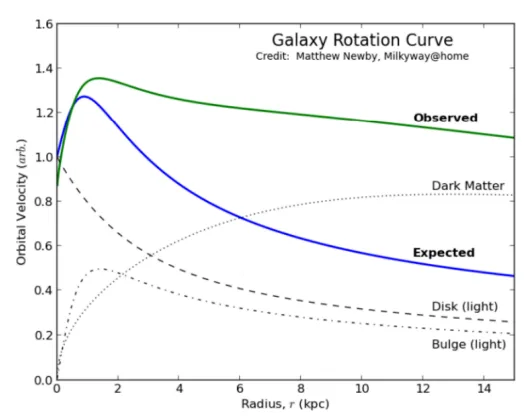
When we look at the universe and see the way it is structured, with the galaxies and superclusters, the first question that comes to mind is why galaxies are present. Galaxies are giant systems of stars, planets, blackholes and other cosmic items, similar to how a workbox contains different tools. But unlike a workbox, a galaxy has no distinct boundary, so we can ask how the galaxies formed instead of all the stars in the universe that would be scattered across them. So astrophysicists have come to a conclusion that all the visible matter in our galaxies that we see is only a small fraction of the composition of the galaxy and thus came up with the term dark matter. Dark matter is a strange substance that is not visible since it does not interact with light, hence its name. Two ways to find the evidence of matter are galactic rotation curves and gravitational lensing, both of which will be covered in this paper.
Over the years, researchers, while measuring the orbital velocities of stars in spiral galaxies like the Milky Way, have found that the velocities of the stars have remained constant or increased while moving away from the centre of the galaxy, which is in opposition to the principle of celestial mechanics. So, technically, there should be more additional mass on the edges of the galaxy to create the gravitational pull on the stars. According to Kepler's 3rd Law, where k is a constant, T is the orbital time period and r is the radius of the orbit, so according to the observations, Kepler's
3rd Law is not followed, hence scientists have hypothesised that something exists that we cannot see but has a strong effect of gravitation inside the galaxy thus assuming it to be dark matter (Meharchandani, 2023).
Figure 1
Galaxy rotation curve
Note. From "Galaxy rotation curve," by M. Newby, 2019, Professor Newby's Educational Ouanta.
(https://sites.temple.edu/profnewby/2019/05/04/g alaxy-rotation-curve/). Copyright 2019 by Matthew Newby.
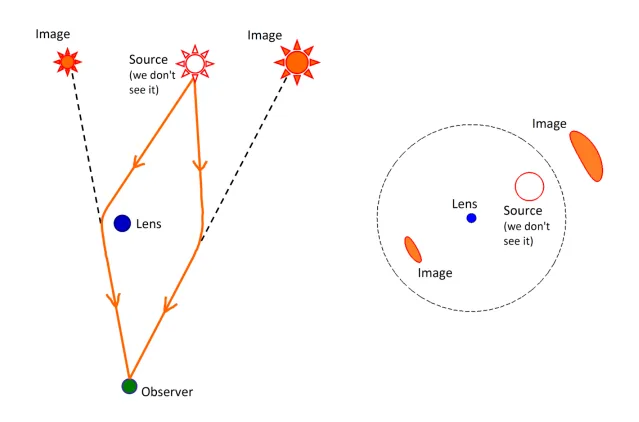
Gravitational lensing, on the other hand, is a phenomenon in which massive objects in the universe like galaxies or a group of galaxies can bend the path of light as it passes through the spacetime continuum, which occurs because of spacetime getting curved by the mass and gravity of the object. If the gravitational lensing is strong enough , then there can be multiple paths of the same object whose light comes to the lenses of our eyes and telescopes. It is observed that for a lensing cluster with total mass M and impact parameter d, the deflection angle is to be:
Therefore, from measurements of the deflection angle and impact parameter, it is

inferred that the total mass M is much higher than the total baryonic mass , thus proving that there is something else in the galaxy that is not visible to us.
Figure 2 Lensing by point mass
Note. From "Gravitational lensing in presence of plasma: Strong lens systems, black hole lensing and shadow," by G.S Bisnovatyi-Kogan & Oleg Y. Tsupko, 2017, Universe, 3(3) (https://doi.org/10.3390/universe3030057). Copyright 2017 by G.S Bisnovatyi-Kogan & Oleg Y. Tsupko.
PROPERTIES OF DARK MATTER
It can be considered dark since it has no interaction or extremely weak interaction with photons. Interaction between dark matter particles must be very weak and so with interactions with baryonic particles. Dark matter cannot be made up of the particles in the Standard Model of Physics since most leptons and baryons are charged (D'Amico et al., 2009).
The Hubble constant
The Hubble constant is a constant that was discovered by the scientist Edwin Hubble, and it is crucial because it provides the estimated age of the universe along with the physical scale. It can also be used to predict how far a star or a galaxy, whose distance is known, is moving away from us due to the expansion of the universe. The velocity in which the galaxy is moving away from us is derived from the formula : Velocity = Hubble Constant x Distance; or, the further a galaxy is from us, the faster it is moving away from us. Currently, the Hubble Constant is about 70 kilometers per second per megaparsec. The reciprocal of the Hubble Constant gives the age of the observable universe, which is estimated to be around 13.7 billion years old (Bhattacharya et al., 2019).
DARK ENERGY
While dark matter was mysterious enough, dark energy is even more mysterious. In 1929, famous American astronomer Edwin Hubble had observed that the farther away a galaxy is in any direction, the faster it is moving away from us. He also noticed that the light of distant galaxies appeared to be of longer wavelengths or reddened. This thus meant that the universe was expanding. However, scientists had thought that since the universe contained a lot of matter and according to the Law of Gravitation by Isaac Newton, more the mass inside the universe meant more would be the gravitational power and thus would then stop accelerating and would either shrink or expand at a steady and controlled rate. In contrast, Riess et Al. (1998) stated that the universe was not contracting or slowing down the expansion rate but actually accelerating more rapidly than before. Type IA supernova cosmic microwave background radiation, baryonic acoustic oscillations and gravitational lensing provide significant evidence of dark energy (Thabet, 2014).
Albert Einstein along with most other scientists in his time believed that the universe was static but in his equations, Einstein had shown that the universe was dynamic, so in order to make sure that his equations proved the universe was static, he introduced a cosmological constant Λ which was the counterbalance to gravity. However Einstein later referred to adding the constant as his biggest blunder, since, in 1929 , Hubble discovered that the universe was actually expanding which disproved Einstein's theory where the universe was static. However, that changed, as two international teams led by Riess

discovered that the universe was expanding at a rapid speed and thus Einstein's constant was actually not a mistake and was used as the repulsive force against gravity. Chaboyer & Krauss (2003) stated that the cosmological constant could be the vacuum energy of space and that it contained non zero energy with negative pressure thus saying that dark energy is a feature of space itself, and it does not get diluted when the universe expands, therefore more the universe expands, more the dark energy is created and more the repulsive force leading to faster expansion of the universe. Physicists also state that dark energy can be a type of dynamic field or fluid which is referred to as quintessence. The influence of quintessence on the expansion of the universe is opposite to that of normal matter and gravity. Physicists call dark energy the cosmological constant if it remains constant over space and time, and, if it changes, then it's called quintessence (Jaewon & Yuki, 2012).
Therefore in simple terms, dark energy is the force that causes the expansion of the universe and accelerates the receding of distant galaxies from the Milky Way. One thing to be noted is that the accelerated expansion of the universe did not start immediately after the big bang, otherwise, galaxies or superclusters would not have been formed in the first place. It's estimated that dark energy's effect started five billion years ago. Dark energy is not clumped around like dark matter, which is clumped around galaxies (Lerner, 2024). Dark energy is spread out uniformly across the whole universe. It also does not emit or interact with light.
Figure 3
Einstein's original equation
Note. From "Ask Ethan: What Is The 'Zero-Point Energy' Of Space?" by E. Siegel, 2020, Big Think (https://bigthink.com/starts-with-a-bang/ask-eth an-what-is-the-zero-point-energy-of-space/). Copyright 2014 by The University of Tokyo; Kavli Ipmu.
Figure 4
Friedmann equation correlating Gravitational, Hubble, and cosmological constants
Note. From "Sayed`s Theory of Dark Energy and Dark Matter Forces Nature," by S.A. El-Mongy, 2024, Journal of Advances in Physics, 22 (https://doi.org/10.24297/jap.v22i.9605). Copyright 2024 by S.A. El-Mongy.
THE END OF OUR UNIVERSE
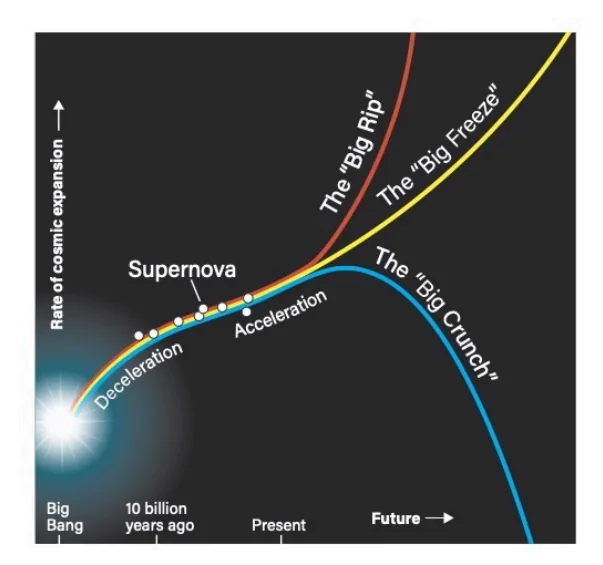
Figure 5
Cosmic expansion possibilities

Note. From "What we do — and don't — know about dark energy," by L.R. House, 2024, Astronomy,
(https://www.astronomy.com/science/what-we-kn ow-about-dark-energy/). Copyright 2024 by L.R. House.
The destiny of our Universe depends primarily on two forces, and the fate of the universe depends upon the strength of the two forces. The first force is gravity, while the second force is dark energy, which is the repulsive force and acts against the force of gravity. Currently, there are three scenarios that can be considered the end of our universe depending upon the battle between gravity and dark energy, the two titans of our universe (Riess & Turner, 2008). The the scenarios are as follows :
Big Rip
In this scenario, the strength of dark energy becomes greater over time than gravity. Dark energy will continue the accelerated expansion of the universe and create more and more empty space on smaller and smaller distances. At first, it will create more empty space between galaxies, and then between stars. Thus when we look at the night sky, it will be a lot more empty since stars and galaxies are moving away from us. But soon in some million years, there would be more empty space created between the planets in the solar system and inside the planets. This will cause Earth to get ripped apart and explode. Over time even atoms are ripped apart by the rapid creation of empty space between them. In the end, only black holes remain which are much smaller than atoms, before exploding with enormous power and finally the fabric of space time in the universe is ripped apart (Mack, 2020).
Big Crunch
In this scenario, the strength of dark energy will decrease over time, and gravity would be the dominant force. In this scenario, the universe will start collapsing and shrink under the force of gravity. At first, galaxy superclusters will start merging, followed by galaxies merging into one another. But soon enough, stars and planets will start coming closer to one another due to the size of the universe decreasing every second. In a few billion years, the universe will start heating up. This is due to the fact that over billions of years, stars, supernovae and other cosmic explosions that had released large amounts of radiation into the universe would be concentrated into the shrinking universe, and, in one point of time, the universe would be hotter than the temperature of stars. Finally, in the end, all the stars and planets and matter in the universe would merge into one and the universe would have two options, one where it would shrink down to a singularity which is a single point with zero size and infinite density, or the universe would be reborn with another new big bang (Andrei et al., 2022).
Big Freeze or Heat Death
This is the most likely scenario and, in this, the strength of dark energy does not decrease or increase but remains constant. Since dark energy exists, the universe continues to expand, which creates more empty space that brings more dark energy and expands the universe faster, which, in turn, creates more empty space, essentially creating a loop. Thus, the universe will accelerate at a fast rate. However, gravity still has command in the smaller cosmic structures. Galaxy groups. like our local group, which contains the galaxies Milky Way and Andromeda, along with other

dwarf galaxies, will be held together by gravity, while galaxies outside the local group will all recede away from us. In some hundred billion years, it will be impossible to detect galaxies that are outside the local group. As the universe keeps on expanding, the gas clouds which form stars will slowly get exhausted, and it is estimated that, in some trillion years, all gas clouds would get exhausted, and most stars would either explode into supernovae or turn into white and red dwarfs, which would also die out soon. The universe would turn into a dark void and after a googol years, all blackholes would evaporate due to the phenomenon known as Hawking radiation. From then, everything would dissolve into elementary particles and be emitted as radiation and even that would decay over time. At this point, entropy would be maximum and the universe would be considered dead as it contains nothing anymore (Baez, 2016).
CONCLUSION
While we are still trying to understand more about dark matter and dark energy, we have some conclusions that we can draw about these mysterious forces. We know that dark matter is responsible for the formation of galaxies as well as exerting a gravitational force. On the other hand, we know that dark energy is responsible for the accelerated expansion of the universe and is the repulsive force against gravity. We also know that neither dark matter nor dark energy consists of any particles in the Standard Model of Particle Physics. Currently, dark matter and dark energy is being researched all over the world, especially in CERN (European Organisation for Nuclear Research), Fermilab near Chicago, Illinois, the Vera C. Rubin Observatory in Chile, and many other research labs. While we don't know much about them, researching dark matter and dark energy could lead to the discovery of new physics, can offer a whole new perspective of our universe and can allow humans to know more about the Big Bang and the early stages of our universe. Since the universe is expanding faster than the speed of light due to dark energy, travelling through time could also be a possibility in the
near future along with other sci-fi inventions that are shown in movies coming true.
REFERENCES
Andrei, C., Ijjas, A., & Steinhardt, P. J. (2022). Rapidly descending dark energy and the end of cosmic expansion. Proceedings of the National Academy of Sciences, 119(15). https://doi.org/10.1073/pnas.2200539119
Arkani-Hamed, N., Finkbeiner, D. P., Slatyer, T. R., & Weiner, N. (2009). A theory of dark matter. Physical Review D, 79(1). https://doi.org/10.1103/physrevd.79.015014
Bhattacharya, R., Bhattacharya, P. K., Bhattacharya, U., Bhattacharya, R., & Banerjee, H. (2019). The Fate of Our Universe: How This Universe Will End. 8(1), 15–277. Retrieved from https://www.researchgate.net/publication/33419 4778_The_Fate_of_Our_Universe_How_This_ Universe_Will_End
Guido D'Amico, Kamionkowski, M., & Sigurdson, K. (2009, July 10). Dark Matter Astrophysics. Retrieved from https://www.researchgate.net/publication/45861 658_Dark_Matter_Astrophysics#pf1f
Krauss, L. M. (2003). Age Estimates of Globular Clusters in the Milky Way: Constraints on Cosmology. Science, 299(5603), 65–69. https://doi.org/10.1126/science.1075631
Lerner, L. (2024, September 20). Dark energy, explained. Retrieved from University of Chicago News website:
https://news.uchicago.edu/explainer/dark-energy -explained
Liu, H. (2023, August 18). How do stars shine? https://doi.org/10.13140/RG.2.2.10659.22560
Mack, K. (2020, October 7). Tearing Apart the Universe. Retrieved from American Scientist website:
https://www.americanscientist.org/article/tearing -apart-the-universe

Meharchandani, N. (2023). Investigating the properties of Dark Matter. International Journal of Scientific Engineering and Research, 11(8), 7–12. https://doi.org/10.70729/se23820092256
NASA. (2018). WMAP- Content of the Universe. Retrieved from Nasa.gov website: https://wmap.gsfc.nasa.gov/universe/uni\_matter. html
Perlmutter, S., Aldering, G., Goldhaber, G., Knop, R. A., Nugent, P., Castro, P. G., … Ellis, R. S. (1999). Measurements of Ω and Λ from 42 High‐Redshift Supernovae. The Astrophysical Journal, 517(2), 565–586. https://doi.org/10.1086/307221
Riess, A. G., Filippenko, A. V., Challis, P., Clocchiatti, A., Diercks, A., Garnavich, P. M., … Tonry, J. (1998). Observational Evidence from Supernovae for an Accelerating Universe and a Cosmological Constant. The Astronomical Journal, 116(3), 1009–1038. https://doi.org/10.1086/300499
Riess, A. G., & Turner, M. S. (2008, September 23). The Expanding Universe: From Slowdown to Speed Up. Retrieved from Scientific American website:
https://www.scientificamerican.com/article/expa nding-universe-slows-then-speeds/
Siegel, E. (2019, January 4). The Five Ways The Universe Might End. Retrieved from Forbes website:
https://www.forbes.com/sites/startswithabang/20 19/01/04/the-five-ways-the-universe-might-end/
Thabet, M. A. R. (2014). The Understanding and Calculation of "Dark Energy and Dark Matter." SSRN Electronic Journal. https://doi.org/10.2139/ssrn.2447616
Warren, S. (2024). What Is the Hubble constant? | University of Chicago News. Retrieved from news.uchicago.edu website: https://news.uchicago.edu/explainer/hubble-cons tant-explained
Woollaston-Webber, V. (2016, October 10). A Big Freeze, Rip or Crunch: How Will the
Universe end? Retrieved from Wired website: https://www.wired.com/story/how-will-universeend/
Yoo, J., & Watanabe, Y. (2012). Theoretical Models Of Dark Energy. International Journal of Modern Physics D, 21(12), 1230002. https://doi.org/10.1142/s0218271812300029