PHÁT TRIỂN NĂNG LỰC KHAI THÁC HIỆU QUẢ TRÍ TUỆ NHÂN TẠO CỦA GIẢNG VIÊN KHI GIẢI QUYẾT CÁC NHIỆM VỤ HỌC THUẬT PHỨC TẠP: NGHIÊN CỨU TẠI CÁC TRƯỜNG ĐẠI HỌC NGOÀI CÔNG LẬP VIỆT NAM TRONG KỶ NGUYÊN SỐ TOÀN CẦU
Nguồn và giấy phép
- Tên bài
- PHÁT TRIỂN NĂNG LỰC KHAI THÁC HIỆU QUẢ TRÍ TUỆ NHÂN TẠO CỦA GIẢNG VIÊN KHI GIẢI QUYẾT CÁC NHIỆM VỤ HỌC THUẬT PHỨC TẠP: NGHIÊN CỨU TẠI CÁC TRƯỜNG ĐẠI HỌC NGOÀI CÔNG LẬP VIỆT NAM TRONG KỶ NGUYÊN SỐ TOÀN CẦU
- Tác giả
- Sơn Ngô Quang Sơn, Hương Bùi Thị Hương, Anh Nguyễn Thị Thuỳ Anh, và cộng sự
- Tạp chí
- Tạp chí Khoa học Trường Đại học Trưng Vương, 2026
- DOI
- 10.64223/tvj.p2026.v2.i7.a129
- Giấy phép
- CC BY 4.0
Đã chuyển định dạng từ bản gốc; nội dung không thay đổi.
Xem bản gốcDEVELOPING LECTURERS' COMPETENCE IN EFFECTIVELY LEVERAGING ARTIFICIAL INTELLIGENCE FOR COMPLEX ACADEMIC TASKS:
A STUDY OF NON-PUBLIC UNIVERSITIES IN VIETNAM IN THE GLOBAL DIGITAL ERA
Ngo Quang Son*
ROR: https://ror.org/05xzsm645
Email: ngoquangson2018@gmail.com
ORCID iD: https://orcid.org/0000-0003-3120-034X
Bui Thi Huong
Thien Than Center for Supporting the Development of
Inclusive Education
Ho Chi Minh City
Email: vientamlyungdung@gmail.com
Nguyen Thi Thuy Anh
Email: thuyanh261nn@gmail.com
Pham Thu Ha
Graduate School, Nguyen Trai University
Email: hathu30789@gmail.com
Cao Thanh Long
Institute of Distance Education, Nguyen Trai University
Email: caothanhlong1107@gmail.com
Le Ha Trang
Faculty of Finance and Banking, Nguyen Trai University
Email: lehatrang2809@gmail.com
Trinh Van Trang
Grand Plaza Hanoi Hotel
Email: trinhvantrang.1893@gmail.com
Duong Thanh Nga
Hanoi College of Commerce and Tourism
Email: duongnga1980@gmail.com
Abstract:
Artificial Intelligence (AI), particularly generative AI, is fundamentally transforming academic work in higher education, reshaping teaching, research, data analysis, scholarly writing, and the resolution of increasingly complex academic tasks. Nevertheless, access to and use of AI does not automatically translate into effective AI-enabled academic capability. The gap between merely "using AI" and developing meaningful human—AI collaboration has therefore emerged as a critical issue in contemporary faculty development.
This study aims to identify and empirically examine the factors shaping lecturers' competence in effectively leveraging AI to address complex academic tasks in non-public universities in Vietnam. Particular attention is given to the roles of AI literacy, AI self-efficacy, Human–AI Collaboration Competence, and critical AI use, while examining institutional AI support as a potential moderating mechanism.
A sequential mixed-methods design is proposed. The qualitative phase employs expert interviews and/or a Delphi process to develop, refine, and validate the conceptual dimensions and measurement indicators. The quantitative phase involves a large-scale survey of lecturers working in Vietnamese non-public universities. Structural equation modelling, using PLS-SEM or CB-SEM depending on data characteristics and model specifications, is employed to examine direct, mediating, and moderating relationships among the proposed constructs.
The study is designed to identify the mechanisms through which AI literacy and AI self-efficacy are transformed into Human–AI Collaboration Competence, Critical AI Use, and AI-Enabled Academic Task Competence, ultimately contributing to lecturers' capacity to perform complex academic tasks effectively. The proposed model provides an integrated explanation of how individual capabilities and institutional conditions jointly shape AI-enabled academic performance.
The study proposes an Al-Enabled Academic Capability Development Model as a conceptual and empirical foundation for faculty development
Nguyen Cong Ty
National Hospital of Obstetrics and Gynecology
Email: tringuyennhg@gmail.com
Nguyen Cong Quan
Dai Nam University
ROR ID: https://ror.org/0031x3y66
Email: ncquan@gmail.com
Nguyen Thi Ngoc Van
Intracom University (INU), Vietnam
Email: vanhbu@gmail.com
Le Manh Hung
Email: hunglemanh1905@gmail.com
Le Thi Ly Na
Lam Dong Department of Education and Training
Email: lynavn89@gmail.com
Article History
Received: Reviewed: Revised: Acceped: Released: 30/6/2026 30/7/2026 15/9/2026 20/9/2026 30/9/2026
DOI: https://doi.org/10.64223/tvj.p2026.v2.i7.a129
in the global digital era. The findings are expected to provide practical implications for non-public universities in designing AI competency development programmes, strengthening institutional AI support ecosystems, and promoting critical, responsible, and academically productive human–AI collaboration.
Keywords: Artificial Intelligence; Generative Artificial Intelligence; AI Literacy; Human–AI Collaboration Competence; AI-Enabled Academic Competence; Complex Academic Tasks; Faculty Competence Development; Non-Public Higher Education.
International Classification Codes:
JEL: I23; O33; M15; D83.
UNESCO: 5802.04; 5803.04; 5801.07. OECD FoR: 05.03; 05.03.02; 01.02.03.
1. Introduction
1.1. Research Context
In recent years, the rapid development of digital technologies has profoundly transformed how academic activities are organized, performed, and evaluated in higher education. While the early phase of digital transformation primarily focused on the digitization of data, platforms, and administrative processes, the emergence and widespread adoption of Generative Artificial Intelligence (GenAI) are driving a new transition from Digital Transformation to Generative AI, subsequently to AI-Augmented Academic Work, and increasingly toward Human– AI Collaboration. Within this trajectory, AI is no longer viewed merely as a technological tool that assists humans in performing isolated tasks; rather, it is increasingly becoming an active component in knowledge formation, information processing, problem solving, and academic creativity.
This transition is particularly significant for the professional work of university lecturers. In traditional academic environments, lecturers have primarily relied on disciplinary expertise, research experience, pedagogical skills, and information technologies to perform their professional responsibilities. However, the development of advanced AI models is reshaping the structure of many complex academic tasks. AI can assist lecturers in searching, synthesizing, and organizing information; generating research ideas; analyzing
and visualizing data; supporting academic writing, editing, and peer-review processes; designing learning materials and instructional activities; developing or updating curricula; managing and exploiting knowledge; simulating problem-solving scenarios; and supporting academic creativity. Accordingly, the value of AI in higher education lies not only in its capacity to automate selected operations but also in its potential to augment human cognitive and task-performance capabilities.
Against this backdrop, the concept of AI-Augmented Academic Work has become increasingly important. Rather than completely replacing lecturers, AI can be employed to enhance their capacity to address complex tasks that simultaneously require analytical reasoning, synthesis, evaluation, creativity, and professional judgment. A research task, for example, may involve a sequence of interconnected activities ranging from problem identification and literature review to theoretical framework development, methodological design, data analysis, and interpretation of findings. At each stage, AI can provide different forms of assistance; nevertheless, the quality of the final academic product remains substantially dependent on the lecturer's ability to define objectives, formulate appropriate requirements, verify AI-generated outputs, identify potential biases or errors, and exercise disciplinary judgment. Therefore, effective AI use cannot be equated with technical proficiency alone; it should instead be conceptualized as an integrated academic competence.
Importantly, this transformation is moving academic work from a human-only work model toward Human–AI Collaboration, in which humans and AI jointly participate in the academic valuecreation process. Within such a collaborative model, AI may perform activities involving largescale information processing, pattern recognition, draft generation, option formulation, or analytical assistance, whereas lecturers retain responsibility for problem formulation, goal orientation, quality evaluation, evidence verification, disciplinary judgment, and final accountability for academic outputs. Consequently, the distinction between an "AI user" and an "AI collaborator" is becoming increasingly important. Two lecturers may use the same AI system yet produce substantially different outcomes depending on their capacities to formulate problems, engineer prompts, evaluate outputs, apply critical reasoning, and integrate AI-generated content with disciplinary knowledge.
This transformation also creates new requirements concerning academic standards, transparency, authorship, data protection, research ethics, and accountability. AI systems may generate seemingly plausible content that nevertheless contains inaccurate information, nonexistent references, or embedded biases. Consequently, effective AI competence in higher education must encompass not only the ability to operate AI tools but also the capacity to recognize their limitations, verify information, protect academic integrity, and employ AI responsibly. The central question is therefore no longer simply "Do lecturers use AI?" but rather a more substantive academic question: "How do lecturers develop the competence to leverage AI effectively in enhancing the quality and efficiency of complex academic tasks?"
For non-public universities in Vietnam, this issue is particularly significant in the context of competition over educational quality, research performance, curriculum innovation, and digital transformation. Developing lecturers' AI competence involves more than training them to operate emerging technological tools; it also concerns the restructuring of academic work practices, the development of professional capabilities, and the formation of a collaborative ecosystem between humans and AI. From this perspective, investigating lecturers' competence in effectively leveraging AI for complex academic tasks can contribute empirical evidence to the transition from AI as a tool toward AI as an academic collaborator, while also providing a scientific foundation for universities to formulate lecturer-development strategies appropriate to the global digital era.
1.2. Research Problem
The rapid diffusion of Generative Artificial Intelligence (GenAI) in higher education has created a fundamental paradox concerning lecturers' professional capability: AI availability does not necessarily translate into AI capability. As AI tools become increasingly accessible, affordable, and integrated into academic platforms, the central issue is no longer simply whether lecturers "have access to AI," but whether they possess the capability to leverage AI effectively, critically, responsibly, and appropriately across different academic tasks.
This paradox becomes particularly evident when two lecturers have equivalent access to the same AI system, use the same technological tool, and are assigned the same academic task. One lecturer may use AI to expand knowledge searches, generate research directions, structure an academic manuscript, support data analysis, design learning materials, or critically review a draft. Another lecturer, however, may merely copy AI-generated outputs, become overly dependent on automated responses, accept unverified information, or fail to recognize the limitations and biases of the system. Thus, similar levels of technological access can produce substantially different levels of academic value. This divergence suggests that the determinants of effective AI use lie not only in
the technology itself but also in users' capabilities and the organizational contexts within which AI is implemented.
A foundational component of this capability is AI literacy, referring to lecturers' understanding of the fundamental principles, capabilities, limitations, risks, and outputs of AI systems. Lecturers need such knowledge to select appropriate tools and align their use with specific academic objectives. Yet AI literacy alone may not be sufficient. Lecturers also require digital competence, namely the capacity to integrate AI with existing digital platforms, datasets, software, and academic workflows. The combination of AI literacy and digital competence enables AI to move beyond being an isolated technological application and become an integrated component of academic task performance.
At the same time, critical thinking is essential for distinguishing between outputs that merely appear plausible and knowledge that is scientifically credible. AI systems can generate coherent and persuasive responses that may nevertheless be inaccurate, incomplete, contextually inappropriate, or biased. Lecturers therefore need to formulate critical questions, examine evidence, identify contradictions, detect potential biases, and evaluate information quality before incorporating AIgenerated outputs into academic work. Closely related to this process is self-efficacy, or lecturers' confidence in their ability to use AI successfully to accomplish professional and academic tasks. Higher levels of self-efficacy may encourage experimentation, continuous learning, and more proactive integration of AI into professional practice.
Another increasingly important dimension is prompting competence. In generative AI environments, the quality of outputs can depend substantially on how users formulate objectives, provide contextual information, structure instructions, and iteratively interact with the system. Effective AI use therefore involves more than simply "asking questions." It encompasses the ability to design structured prompts, provide relevant input, refine interaction strategies, and evaluate outputs across multiple iterations. However, prompting competence can generate meaningful academic value only when combined with verification competence. Lecturers must verify sources, data, arguments, citations, and AI-generated results before incorporating them into research, teaching, or other academic activities.
Furthermore, AI use in higher education cannot be separated from ethical awareness. Issues related to academic integrity, authorship, privacy, data protection, transparency in AI use, algorithmic bias, and accountability for academic outputs introduce new professional requirements for lecturers. An individual may possess sophisticated technical AI skills, but without adequate ethical awareness, AI use may still generate adverse consequences for academic quality and integrity. AI capability should therefore be conceptualized as a multidimensional construct in which technical, cognitive, and ethical competencies mutually reinforce one another.
Nevertheless, individual capability is not the only determinant of effective AI use. Institutional support and organizational culture may create important enabling conditions or barriers. Institutional policies governing AI use, professional development programs, access to digital infrastructure, technical support, communities of practice, incentives for innovation, and organizational norms concerning responsible AI use can all influence how lecturers adopt and integrate AI into their work. An organizational environment that encourages experimentation, knowledge sharing, and continuous learning may facilitate the use of AI as a capabilityenhancing technology. Conversely, unclear policies or an organizational culture that does not support innovation may constrain such development.
Accordingly, the central research problem addressed in this study is not simply to determine how frequently lecturers use AI, but to explain which factors constitute and shape their capability to leverage AI effectively when performing complex academic tasks. Addressing this problem requires moving beyond a linear model of "AI access → AI use → academic outcomes" toward an integrated perspective that considers individual and organizational determinants simultaneously. In particular, it is necessary to examine how AI literacy, digital competence, critical thinking, selfefficacy, prompting competence, and verification competence interact with ethical awareness, institutional support, and organizational culture in shaping lecturers' AI capability.
From this perspective, the study addresses a theoretically and practically significant question: why do lecturers with similar access to AI tools derive substantially different academic value from the same technology? Answering this question may help shift scholarly attention from AI access to AI capability, from merely "using AI" to "leveraging AI competently," and from AI as a tool toward AI as a capability-enhancing collaborator. Particularly in the context of non-public universities in Vietnam, where digital transformation and innovation in teaching and research are becoming increasingly important, identifying the structure and determinants of this capability can provide an empirical foundation for lecturer-development programs, AI governance policies, and organizational cultures aligned with the emerging AI era.
1.3. Research Gap
Although Artificial Intelligence (AI), particularly Generative AI (GenAI), is being rapidly university lecturers develop and apply AI capabilities to perform highly complex academic tasks. A substantial body of research focuses on AI adoption, AI acceptance, behavioral intention, and AI usage, whereas a more fundamental professional issue concerns how access to and use of AI can be transformed into purposeful, critical, and responsible AI capability. Accordingly, this study identifies four major research gaps.
Gap 1 – Conceptual Gap
The first gap concerns the conceptualization of AIrelated competence. Much of the existing literature on AI in education focuses on constructs such as AI adoption, AI acceptance, behavioral intention, and AI usage, primarily addressing whether users accept and employ the technology. However, frequent AI use does not necessarily indicate the ability to leverage AI effectively. A lecturer may use AI extensively while still lacking the capacity to evaluate output quality, verify information, adjust interaction strategies, or integrate AI-generated content with disciplinary knowledge. Thus, there remains a conceptual gap concerning the capability to leverage AI for complex academic tasks. This study addresses this gap by shifting the focus from "whether lecturers use AI" to "how lecturers are capable of leveraging AI to generate academic value."
Gap 2 – Capability Gap
The second gap concerns the distinction between AI usage and Human–AI Collaboration Competence. Using AI does not necessarily mean that an individual can collaborate effectively with AI. In emerging human–AI work environments, lecturers need to determine which tasks should be delegated to AI, formulate appropriate instructions, engage in iterative interaction, evaluate outputs, verify evidence, refine results, and integrate AI assistance with professional judgment. Accordingly, the conceptualization needs to move beyond the notion of an AI User toward that of an AI-Enabled Academic Professional - a lecturer who incorporates AI into professional capability and knowledgecreation processes. This gap indicates the need for a capability-based approach that goes beyond tool operation and encompasses the cognitive, technical, critical, and ethical dimensions of human–AI collaboration.
Gap 3 – Task-Complexity Gap
The third gap arises from the tendency of existing studies to treat AI as a relatively general-purpose tool across different academic tasks. In practice, however, the value of AI and the competencies required to use it may vary substantially according to task complexity. This study therefore distinguishes between Routine Academic Tasks and Complex Academic Tasks.
| Routine Academic Tasks | Complex Academic Tasks |
|---|---|
| Email drafting | Research design |
| Text summarization | Theory synthesis and development |
| Translation | Theoretical model development |
| Question generation | Data analysis and interpretation |
| Basic idea generation | Research problem solving |
| Basic content drafting | Academic research-article development |
For routine tasks, AI may primarily enhance speed and operational efficiency. Complex academic tasks, by contrast, require lecturers to integrate AI with disciplinary knowledge, critical reasoning, evidence evaluation, professional judgment, and creativity. Studying AI capability in the context of complex tasks can therefore provide a deeper understanding of AI-augmented academic performance and Human–AI collaboration than approaches based solely on AI-use frequency.
Gap 4 – Contextual Gap
The fourth gap concerns the empirical context. Although research on AI in higher education is expanding rapidly, empirical evidence focusing specifically on lecturers in Vietnamese nonpublic universities remains limited. This context deserves particular attention because non-public universities operate under distinctive conditions involving competition for academic talent, digital transformation, publication pressures, educational innovation, technological resources, university governance, and international integration. These
conditions may simultaneously create incentives and constraints for lecturers' AI capability development.
Importantly, technological access does not necessarily translate into technological capability when institutional support, professional development, innovation-oriented organizational culture, and responsible AI norms are insufficient. Research focusing on lecturers in Vietnamese nonpublic universities can therefore contribute not only evidence from an underexamined context but also a basis for examining how organizational and institutional conditions shape the development of AI capability.
Taken together, these four gaps reveal an important integrated research deficit: there remains insufficient empirical evidence systematically explaining how individual capabilities, human– AI collaboration competence, task characteristics, and organizational context jointly shape lecturers' ability to leverage AI for complex academic tasks. This study therefore shifts the analytical focus from AI adoption → AI usage toward AI capability → Human–AI collaboration → AI-augmented academic task performance, while situating this process within the specific institutional context of Vietnamese non-public universities.
1.4. Research questions
RQ1: What factors determine lecturers' competence in effectively leveraging artificial intelligence for complex academic tasks?
RQ2: How does AI literacy influence lecturers' AI-enabled academic task competence?
RQ3: Does human–AI collaboration competence mediate the relationship between AI literacy and complex academic task performance?
RQ4: How do critical AI use and AI self-efficacy influence lecturers' ability to perform complex academic tasks?
RQ5: How does institutional AI support strengthen lecturers' AI-enabled academic task competence?
2. Literature Review
2.1. Artificial Intelligence in Higher Education and Academic Work
The rapid development of Artificial Intelligence (AI), particularly Generative Artificial Intelligence (GenAI), is substantially transforming how academics perform professional and scholarly tasks in higher education. AI is no longer limited to information retrieval, summarization, or routine administrative support. Increasingly, it is being incorporated into complex academic activities, including instructional-material development, academic writing, research ideation, data analysis, content evaluation, curriculum design, and problem solving. Accordingly, AI is evolving from a supplementary technological tool into an integral component of the intellectual and professional ecosystem of academic work.
Previous studies suggest that AI adoption in higher education may provide substantial opportunities for improving work efficiency, supporting personalized teaching, and expanding access to knowledge resources. Nevertheless, effective AI use cannot be explained solely by technological access. Academics need to understand AI limitations, determine which tasks are appropriate for AI assistance, formulate effective prompts or instructions, critically evaluate AI-generated outputs, and integrate such outputs with. disciplinary expertise. These capabilities are particularly important when academics address complex tasks in which performance depends on critical thinking, professional judgment, creativity, and academic responsibility.
2.2. AI Literacy and AI Self-Efficacy
AI literacy represents an important foundation for effective AI use. It extends beyond knowing how AI systems operate and includes the ability to recognize AI opportunities and limitations, evaluate AI-generated outputs, use AI responsibly, and apply AI appropriately to specific contextual tasks. In higher education, AI literacy should therefore be conceptualized as a multidimensional construct integrating technological knowledge, cognitive capabilities, practical skills, and ethical awareness.
Nevertheless, possessing AI literacy does not necessarily mean that an academic can effectively exploit AI in complex tasks. An important psychological mechanism is AI self-efficacy, defined as an individual's belief in their capability to use AI to accomplish specific tasks. From a self-efficacy perspective, perceived capability can influence task engagement, persistence, and responses to difficulties. In AI-enabled academic work, lecturers may possess substantial knowledge about AI but still underutilize it if they lack confidence in applying AI to demanding professional tasks.
Consequently, AI literacy and AI self-efficacy should be examined jointly. AI literacy may provide the cognitive foundation for AI use, whereas AI selfefficacy may facilitate the translation of knowledge into actual usage. However, neither construct alone fully explains the capacity to coordinate human expertise and AI capabilities when addressing complex academic tasks.
2.3. Human–AI Collaboration Competence
An increasingly important direction in AI research is the shift from AI use toward human–
AI collaboration. For relatively simple tasks, AI may function as a tool for performing a specific operation. In complex tasks, however, effectiveness depends on an appropriate division of responsibilities between human capabilities and AI capabilities. Humans contribute goals, contextual understanding, disciplinary expertise, judgment, and accountability, while AI can support ideation, information processing, pattern recognition, scenario generation, and rapid feedback. From this perspective, human–AI collaboration competence can be conceptualized as the ability to determine when AI should be used, select appropriate interaction strategies, allocate tasks between humans and AI, evaluate and refine AI outputs, and retain meaningful human oversight and accountability for the final outcome. This represents a more advanced capability than simply knowing how to operate an AI application. For university lecturers, human–AI collaboration competence is particularly relevant to teaching, research, and scholarly development. Frequent AI use does not necessarily indicate effective collaboration. Academics may use AI extensively while remaining dependent on AIgenerated outputs or lacking sufficient capacity to assess their accuracy, relevance, originality, and disciplinary appropriateness.
2.4. Critical AI Use and Complex Academic Task Performance
A central issue in AI research in higher education concerns the distinction between AI use and critical AI use. AI systems can generate content rapidly and persuasively, yet their outputs may contain inaccuracies, biases, contextual deficiencies, or academically inappropriate information. Consequently, the ability to verify information, cross-check sources, identify errors, and determine the appropriate degree of reliance on AI outputs represents an important advanced dimension of AI competence.
Critical AI use refers to the capacity to employ AI while maintaining critical reasoning, cognitive control, and professional responsibility. In complex academic tasks, lecturers need to treat AI as a cognitive collaborator rather than as an automatically trustworthy source of knowledge. This requires an iterative human–AI process: defining the problem, requesting AI assistance, evaluating the output, refining the interaction, independently verifying relevant information, and making final decisions based on disciplinary expertise. Accordingly, complex academic task performance can be conceptualized as the outcome of several interconnected competencies. AI literacy provides an essential knowledge foundation; AI self-efficacy supports confidence and engagement; human–AI collaboration competence facilitates effective coordination; and critical AI use helps ensure that AI-supported work maintains academic quality, accuracy, professional judgment, and meaningful human oversight.
3. Theoretical Framework
3.1. Human Capital Theory
According to Human Capital Theory, knowledge, skills, competencies, and experience accumulated through education, training, and professional practice constitute forms of capital that generate value and enhance individual and organizational productivity. In the context of the rapid development of artificial intelligence, this study extends the traditional perspective by conceptualizing AI competence as a new form of human capital for university lecturers.
AI competence encompasses more than the technical ability to operate AI tools. It also includes AI literacy, digital competence, prompting capability, critical thinking, output verification, ethical awareness, and the capacity to integrate AI with disciplinary knowledge. When accumulated through training, experience, and professional practice, these capabilities can enhance lecturers' capacity to perform complex academic tasks.
From a Human Capital Theory perspective, investment in lecturers' AI competence can therefore be understood as an investment in human capital that enhances AI-enabled academic task competence and facilitates emerging forms of work based on Human–AI Collaboration. The theory consequently provides a foundation for explaining why differences in lecturers' AI-related knowledge, skills, and competencies may lead to differences in their ability to perform complex academic tasks effectively.
3.2. Technology–Organization–Environment (TOE)
The Technology–Organization–Environment (TOE) framework provides a theoretical foundation for explaining how conditions beyond the individual level influence the adoption, implementation, and effective use of technology within organizations. In this study, TOE is extended to explain how technological readiness, organizational support, and institutional environment create enabling conditions or constraints for lecturers' development of AI capability in performing complex academic tasks.
At the technology level, technological readiness reflects the availability and quality of digital infrastructure, access to AI tools, data-system capacity, connectivity, and compatibility between AI technologies and existing academic platforms. Technologies that are accessible, reliable, and aligned with academic workflows may facilitate
lecturers' experimentation with and deeper integration of AI into professional activities.
At the organizational level, organizational support represents institutional assistance through AI training and professional development, technical support, resources, internal policies, communities of practice, and incentives for innovation. Such support can reduce learning barriers and encourage lecturers to move from individual and ad hoc AI use toward systematic integration of AI into academic work.
At the environmental level, institutional environment encompasses regulations, professional norms, competitive pressures, and broader digitaltransformation trends in higher education. The institutional environment can shape both the incentives and constraints associated with AI use, particularly with regard to transparency, ethics, data protection, and academic accountability. TOE therefore complements Human Capital Theory by emphasizing that AI capability is not developed solely from individual resources but is also shaped by the broader technological, organizational, and institutional ecosystem in which lecturers perform their academic work.
3.3. Social Cognitive Theory
Social Cognitive Theory (SCT) provides a theoretical foundation for explaining the role of individual cognition, behavior, and environmental conditions in the development of technology-related competence. According to SCT, individuals' beliefs in their ability to successfully perform a particular behavior can influence their willingness to engage, effort, persistence, and responses to challenging tasks. In the context of AI, this study focuses on AI self-efficacy, defined as lecturers' belief in their ability to use AI effectively to perform academic tasks.
Lecturers with higher AI self-efficacy are more likely to proactively explore AI tools, experiment with alternative interaction strategies, adapt their approaches when difficulties arise, and sustain continuous learning. These behaviors constitute AI engagement, referring to the extent to which lecturers interact with AI proactively, purposefully, consistently, and deeply. Through repeated practice, feedback, and accumulated experience, AI engagement can contribute to the development and reinforcement of AI competence.
Accordingly, this study proposes the conceptual mechanism AI Self-Efficacy → AI Engagement → AI Competence, whereby AI engagement may function as a mechanism through which individual beliefs are translated into practical capability. SCT therefore helps explain why lecturers with similar access to AI technologies may nevertheless develop different levels of AI competence: such differences may arise from variations in self-confidence, proactive engagement, and learning through continued interaction with AI.
3.4. Human–AI Collaboration Perspective
The Human–AI Collaboration Perspective represents the most distinctive and emerging theoretical pillar of this study, reflecting a fundamental shift in how the relationship between humans and artificial intelligence is conceptualized in academic work. Rather than adopting a "Human versus AI" logic, in which AI is primarily viewed as a technology capable of replacing selected human activities, this study adopts a "Human + AI → Augmented Academic Capability" perspective. From this view, the primary value of AI does not necessarily lie in replacing lecturers, but in its capacity to augment their cognitive, analytical, creative, and proble m-solving capabilities.
Within this collaborative model, humans and AI perform complementary functions. AI can support large-scale information processing, pattern recognition, content generation and transformation, option formulation, data analysis, and scenario exploration. Lecturers, however, remain central to problem formulation, goal setting, provision of disciplinary context, evidence evaluation, result verification, professional judgment, and ultimate academic accountability. Accordingly, the critical capability is not simply AI usage, but the ability to effectively allocate, coordinate, and integrate human and AI capabilities.
From this perspective, Human–AI Collaboration Competence refers to lecturers' ability to design, coordinate, monitor, and evaluate interactions with AI in order to produce high-quality academic outcomes. This competence may serve as a bridge between AI literacy and complex academic task performance, because knowledge about AI creates academic value only when translated into purposeful collaboration that remains subject to meaningful human oversight. The Human–AI Collaboration Perspective therefore extends the concept of lecturers' professional competence from technological tool use toward Augmented Academic Capability—an enhanced form of academic capability created through the deliberate integration of human intelligence and artificial intelligence.
4. Proposed Research Model
Building on the identified research gaps and the integration of Human Capital Theory, Technology– Organization–Environment (TOE), Social Cognitive Theory, and the Human–AI Collaboration Perspective, this study proposes a research model to
explain how AI literacy is transformed into lecturers' capability to perform complex academic tasks. The model follows the sequential pathway: AI Literacy → AI Self-Efficacy → Human–AI Collaboration Competence → Critical AI Use → AI-Enabled Academic Task Competence → Complex Academic Task Performance.
In this model, AI Literacy represents the initial cognitive foundation, providing lecturers with the knowledge and understanding required to recognize AI capabilities, limitations, and appropriate applications. This foundation is expected to contribute to AI Self-Efficacy, defined as lecturers' confidence in their ability to use AI effectively to accomplish academic tasks. As selfefficacy increases, lecturers may become more proactive in interacting with, experimenting with, and coordinating AI systems, thereby developing Human–AI Collaboration Competence.
Human–AI Collaboration Competence is subsequently expected to foster Critical AI Use, reflecting lecturers' ability to employ AI purposefully, critically, responsibly, and with appropriate verification. This process contributes to AI-Enabled Academic Task Competence, referring to lecturers' capability to leverage AI in planning, performing, evaluating, and refining academic tasks. Such competence is ultimately expected to enhance Complex Academic Task Performance, particularly for tasks involving research design, theoretical synthesis, data analysis, model development, research problem solving, and academic creativity.
Importantly, Institutional AI Support is proposed as a moderating variable. It represents the extent to which universities provide policies, training, infrastructure, technical assistance, resources, and an organizational environment that encourages responsible AI use. When Institutional AI Support is stronger, the relationships involved in transforming AI literacy and related individual capabilities into AI-enabled academic task competence may become stronger. This approach enables the model to simultaneously account for individual capability and organizational conditions, thereby providing a more comprehensive explanation of how AIaugmented academic capability develops among university lecturers.
Conceptual Model INSTITUTIONAL AI SUPPORT (Moderator) │ ▼ AI LITERACY ──► AI SELF-EFFICACY ──► HUMAN–AI COLLABORATION COMPETENCE │ ▼ CRITICAL AI USE │ ▼ AI-ENABLED ACADEMIC TASK COMPETENCE │ ▼
COMPLEX ACADEMIC TASK PERFORMANCE
5. Research Constructs and Variables 5.1. AI Literacy – AIL
In this study, AI Literacy (AIL) is conceptualized as lecturers' multidimensional capability to understand, evaluate, apply, and use AI responsibly in professional and academic activities. AI literacy goes beyond knowledge of how AI systems operate; it also encompasses the ability to recognize AI capabilities and limitations, evaluate the quality of AI-generated outputs, select appropriate applications, and consider ethical implications when using AI.
AIL is structured around five core components. AI knowledge represents lecturers' foundational knowledge of AI concepts, principles, and technologies. AI understanding reflects their ability to understand how AI systems generate, process, and transform information and to recognize system limitations. AI evaluation refers to the capacity to assess the accuracy, reliability, relevance, and quality
of AI-generated outputs. AI application represents the ability to select and apply AI appropriately according to the objectives, context, and requirements of academic tasks. Finally, AI ethical awareness reflects awareness of academic integrity, authorship, privacy, data protection, transparency, and accountability in AI use. Together, these five dimensions provide the cognitive and normative foundation for the development of AI Self-Efficacy, Human–AI Collaboration Competence, and AI-Enabled Academic Task Competence. AIL is therefore positioned as a foundational construct in the proposed research model, helping explain why access to AI does not necessarily translate into the capability to leverage AI effectively.
5.2. AI Self-Efficacy – AISE
In this study, AI Self-Efficacy (AISE) is conceptualized as lecturers' confidence in their ability to select, operate, interact with, and effectively leverage artificial intelligence to accomplish professional and academic tasks. Unlike AI Literacy, which primarily concerns knowledge and understanding of AI systems, AISE focuses on an individual's belief in their capability to successfully perform AI-related actions in specific task and contextual conditions. Accordingly, two lecturers with comparable levels of AI knowledge may nevertheless demonstrate different levels of AI self-efficacy and achieve substantially different outcomes when working with AI.
In the context of complex academic tasks, AISE comprises five major dimensions.
First, confidence in AI selection refers to lecturers' confidence in identifying and selecting appropriate AI tools or models according to the objectives, content, and requirements of a particular task.
Second, confidence in prompt design, which involves the ability to formulate clear instructions, provide relevant context, specify desired outputs, and iteratively refine prompts to improve response quality.
Third, confidence in interacting with AI reflects the ability to engage in multi-turn interactions, ask follow-up questions, challenge AI-generated responses, and use AI as a cognitive partner in academic work.
Fourth, confidence in adjusting and refining AI outputs concerns the ability to identify limitations, request revisions, integrate AI-generated materials with disciplinary knowledge, and verify information before academic use.
Fifth, confidence in problem solving with AI refers to lecturers' perceived ability to employ AI to analyze problems, generate alternative solutions, compare options, and support academic decisionmaking.
From a theoretical perspective, higher AISE is expected to encourage greater proactive experimentation, persistence, and purposeful engagement with AI, thereby facilitating the development of Human–AI Collaboration Competence and strengthening lecturers' AIenabled academic task competence.
5.3. Human–AI Collaboration Competence (HAICC)
In this study, Human–AI Collaboration Competence (HAICC) is proposed as a central construct capturing lecturers' ability to decompose, delegate, coordinate, monitor, and integrate human and AI capabilities to accomplish complex academic tasks. Whereas AI Literacy primarily reflects knowledge and understanding of AI and AI Self-Efficacy concerns confidence in using AI, HAICC emphasizes the capacity to orchestrate and govern purposeful human–AI collaboration throughout the task-performance process. From this perspective, AI is not merely treated as a technological support tool but as a component of a task-performance system in which lecturers retain responsibility for task objectives, supervision, evaluation, and final academic judgment.
HAICC comprises seven interrelated dimensions.
First, Task Decomposition refers to the ability to break complex academic tasks into manageable components and determine which elements should be performed by humans and which can be supported by AI.
Second, AI Delegation concerns the ability to assign appropriate subtasks to AI while retaining human responsibility for activities requiring disciplinary expertise, contextual understanding, ethical reasoning, or professional accountability.
Third, Prompt Engineering represents the ability to design, structure, and iteratively optimize prompts to guide AI toward task-relevant academic outputs.
Fourth, Iterative Interaction refers to the ability to improve results through repeated cycles of prompting, questioning, feedback, verification, and refinement rather than accepting an initial AI response without further interaction.
Fifth, Human Oversight emphasizes lecturers' continuous supervision and control over AI-assisted processes and outputs.
Sixth, Output Evaluation reflects the ability to assess AI-generated content in terms of accuracy, reliability, relevance, coherence, quality, and academic validity.
Seventh, Human Judgment represents the capacity to integrate disciplinary expertise, critical reasoning, contextual knowledge, professional experience, and ethical responsibility when making final decisions about AI-assisted academic work.
Theoretically, HAICC functions as a key mechanism linking AI Literacy and AI Self-Efficacy with AI-enabled Academic Task Competence. It therefore shifts the analytical focus from "whether lecturers use AI" toward the more consequential question of "how lecturers orchestrate collaboration with AI to produce high-quality academic outcomes." This conceptualization provides a theoretically meaningful basis for examining HAICC as a mediating construct within the proposed research model.
5.4. Critical AI Use – CAU
In this study, Critical AI Use (CAU) is conceptualized as lecturers' capability to avoid passively accepting, copying, or directly adopting AIgenerated outputs and instead engage in a systematic process of verification, critical evaluation, evidence appraisal, and selective academic integration. From this perspective, the quality of AI use should not be assessed merely by frequency of use or the speed at which AI can generate content. Rather, it depends on the extent to which lecturers can critically control, scrutinize, and transform AI-generated outputs into academically valid and contextually appropriate knowledge.
CAU is therefore represented as a process chain: AI-generated → Human Verification → Critical Evaluation → Academic Integration. This sequence captures a fundamental shift from "AIgenerated content" to "human-validated academic knowledge." AI can rapidly generate texts, arguments, summaries, hypotheses, analytical options, and references; however, an AI-generated output should not automatically be regarded as accurate, evidence-based, methodologically appropriate, or academically reliable. CAU consequently functions as a cognitive and academic quality-control mechanism within Human–AI collaboration.
CAU consists of six core dimensions.
First, Source Verification refers to lecturers' ability to trace and authenticate the sources underlying AI-generated claims, concepts, data, and references. This includes determining whether a cited source actually exists, whether it supports the claim attributed to it, and whether it is sufficiently credible for academic use.
Second, Hallucination Detection concerns the ability to identify fabricated or unsupported AI outputs, including nonexistent references, incorrect DOIs, fabricated data, inaccurate quotations, and claims presented with unwarranted certainty. This capability is particularly important in scholarly research because seemingly minor inaccuracies in references or evidence can compromise the integrity of an entire academic argument.
Third, Evidence Checking reflects the ability to cross-check AI-generated claims against independent scholarly sources, datasets, empirical findings, and other forms of evidence. Rather than merely asking whether an AI-generated statement appears plausible, lecturers should determine what evidence supports the claim, whether the evidence is relevant, and whether it genuinely justifies the conclusion being presented.
Fourth, Bias Awareness refers to the ability to recognize potential biases embedded in AI systems, training data, source selection, linguistic patterns, or generated outputs. Lecturers should remain attentive to issues such as data bias, source-selection bias, linguistic bias, cultural bias, and the presentation of particular perspectives as apparently objective conclusions.
Fifth, Methodological Scrutiny concerns the critical assessment of research methods, analytical models, assumptions, procedures, and interpretations proposed or supported by AI. This dimension is particularly relevant to complex academic tasks such as research-model development, methodological selection, scale construction, quantitative or qualitative analysis, and interpretation of empirical findings. An AIgenerated methodological recommendation may appear reasonable while remaining inappropriate for a particular research question, dataset, disciplinary tradition, or research context.
Sixth, Citation Verification represents lecturers' ability to verify the existence, accuracy, relevance, retrievability, and substantive correspondence of references, authors, publication years, DOIs, and cited claims contained in AI-assisted academic outputs. This dimension is essential for preventing fabricated citations, inaccurate bibliographic information, and misrepresentation of source content.
Theoretically, CAU can be understood as a mechanism through which Human–AI Collaboration Competence is transformed into trustworthy academic value. Whereas HAICC addresses "how humans coordinate and collaborate with AI," CAU addresses "how humans critically control and validate what AI produces." CAU therefore provides a theoretically meaningful bridge between Human– AI Collaboration Competence and AI-Enabled Academic Task Competence, helping ensure that
AI integration strengthens rather than undermines the accuracy, transparency, accountability, and scholarly quality of academic work.
5.5. AI-Enabled Academic Task Competence (AIATC)
In this study, AI-Enabled Academic Task Competence (AIATC) is proposed as the core construct of the research model. AIATC is conceptualized as lecturers' integrated capability to mobilize, coordinate, and control human intellectual resources and AI capabilities to plan, perform, evaluate, and refine academic tasks effectively, accurately, responsibly, and appropriately within specific disciplinary contexts. The construct is distinct from general AI use. A lecturer may be proficient in operating an AI tool without necessarily being capable of translating that proficiency into high-quality outcomes in research, teaching design, academic writing, data analysis, or complex problem solving.
Theoretically, AIATC represents the transition from "AI usage" to "AI-enabled academic capability." The value of AI does not lie simply in whether lecturers use AI, but in their ability to integrate AI as a cognitive and technological resource within the academic task-performance process. Accordingly, AIATC occupies a central position in the proposed model, linking antecedent capabilities—including AI Literacy, AI Self-Efficacy, Human–AI Collaboration Competence, and Critical AI Use—to academic task outcomes. AIATC can be operationalized through five core domains of academic competence.
First, Research Competence refers to lecturers' ability to leverage AI in identifying and refining research problems, reviewing and synthesizing literature, formulating research questions or hypotheses, developing theoretical frameworks and research models, selecting appropriate methods, and supporting the interpretation of research findings. The emphasis is not on delegating the entire research process to AI, but on integrating AI into research workflows while maintaining human scholarly control.
Second, Teaching-Design Competence represents the ability to use AI to design and improve learning objectives, course content, learning activities, simulations, assessment questions, instructional materials, and pedagogical strategies according to learners' characteristics and educational needs. This competence emphasizes the integration of AI's generative and adaptive capabilities with lecturers' pedagogical expertise and understanding of learners.
Third, Academic Writing Competence reflects the ability to use AI to support argument structuring, idea development, language refinement, coherence improvement, and the preparation of scholarly manuscripts while preserving originality, accuracy, transparency, and academic integrity. AI is treated as an augmentation resource within the writing process, whereas responsibility for the arguments, evidence, and final academic content remains with the lecturer.
Fourth, Data-Analysis Competence concerns lecturers' ability to leverage AI in data cleaning and organization, the selection or implementation of appropriate analytical techniques, interpretation of results, and identification of patterns or relationships in data. This competence also requires the ability to examine analytical assumptions, verify AI-assisted results, and identify inappropriate or unsupported interpretations.
Fifth, Complex Problem-Solving Competence refers to the ability to employ AI to analyze multifaceted problems, identify underlying causes, generate and compare alternative solutions, explore scenarios, assess potential consequences, and support informed academic decision-making. Its central feature is the integration of AI's informationprocessing capabilities with human critical thinking, disciplinary expertise, experience, and professional judgment.
Thus, AIATC measures not merely the extent to which lecturers use AI, but their capacity to transform AI into effective academic task capability. This distinction provides a strong conceptual basis for positioning AIATC as the central construct of the proposed research model and for examining how individual capabilities, human–AI collaboration, and critical AI use contribute to lecturers' capacity to perform increasingly complex academic work.
5.6. Complex Academic Task Performance (CATP)
In this study, Complex Academic Task Performance (CATP) is defined as the ultimate outcome variable of the proposed research model. CATP captures the extent to which lecturers are able to produce high-quality, efficient, accurate, creative, rigorous, and productive academic outcomes when performing complex tasks with AI support. Whereas AI-Enabled Academic Task Competence (AIATC) addresses the question of "To what extent are lecturers capable of performing academic tasks with AI?", CATP focuses on "How well do they ultimately perform those tasks and what quality of outcomes do they achieve?" This distinction is important for avoiding conceptual overlap between competence and performance.
Complex academic tasks may include research problem formulation and design, theoretical
synthesis and argument development, complex instructional design, data analysis and interpretation, scholarly writing, model or solution development, and problem solving involving multiple interacting factors. Such tasks require more than information processing; they demand higher-order thinking, disciplinary knowledge, scholarly judgment, critical reasoning, and the integration of multiple cognitive resources. Accordingly, the contribution of AI should be evaluated through the quality of final academic outcomes rather than merely through the frequency or intensity of technology use.
CATP is operationalized through seven core outcome dimensions.
First, Quality refers to the extent to which academic outputs meet expectations concerning content, structure, relevance, coherence, and disciplinary value. High-quality outputs should be appropriately aligned with the objectives and contextual requirements of the task.
Second, Efficiency concerns the ability to complete complex academic tasks with an appropriate allocation of time, effort, and resources. Although AI may reduce the time required for certain activities, efficiency should be understood as process optimization without compromising academic quality.
Third, Accuracy reflects the correctness of information, data, reasoning, analysis, and conclusions contained in academic outputs. In AI-supported academic work, accuracy is closely associated with the systematic verification of information and the elimination of unsupported, fabricated, or erroneous AI-generated claims.
Fourth, Creativity represents the capacity to generate novel and valuable ideas, approaches, solutions, models, or academic products. AI may expand the space of possible ideas, but the creativity of the final outcome should reflect the meaningful integration of AI-generated possibilities with lecturers' own disciplinary knowledge, experience, and creative reasoning.
Fifth, Problem-Solving refers to the extent to which lecturers can identify complex problems, analyze their underlying causes, develop alternative solutions, evaluate available options, and formulate appropriate responses. This dimension is particularly relevant to open-ended academic tasks for which there is no single predetermined solution.
Sixth, Scholarly Rigor concerns the extent to which academic outputs are grounded in logical reasoning, credible evidence, appropriate methodology, verifiable sources, and established standards of scholarly research. Scholarly rigor also encompasses transparency, traceability, methodological integrity, and academic responsibility when AI is incorporated into the task-performance process.
Seventh, Productivity reflects the ability to increase the volume or value of academic outputs within a given period and with available resources, including scholarly publications, teaching materials, research outputs, analytical products, and other academic deliverables. Productivity should not be interpreted simply as producing more outputs, but as generating greater academic value while maintaining quality, accuracy, and scholarly rigor.
Within the proposed model, CATP represents the ultimate outcome of the capability-development chain: AI Literacy → AI Self-Efficacy → Human–AI Collaboration Competence → Critical AI Use → AI-Enabled Academic Task Competence → Complex Academic Task Performance. This configuration enables the study to explain the transformation from AI-related knowledge and self-beliefs, through Human–AI collaboration and critical control, to AIenabled task competence and ultimately to highquality outcomes in complex academic work.
6. Research Hypotheses
Drawing on theoretical perspectives on artificial intelligence (AI) competence, self-efficacy, human– AI collaboration, and digital transformation in higher education, this study proposes a conceptual model comprising 12 hypotheses (H1–H12). The model posits that AI literacy provides a foundational capability that contributes to AI self-efficacy and human–AI collaboration competence, while also exerting direct and indirect effects on AI-enabled academic task competence and complex academic task performance. Furthermore, institutional AI support is conceptualized as a contextual condition that may alter the strength of the relationship between AI competence and complex academic task performance.
H1: AI literacy positively influences AI selfefficacy.
This hypothesis posits that higher levels of AI literacy and proficiency foster greater confidence in one's ability to leverage AI for academic tasks. AI literacy encompasses not only technical knowledge but also the ability to understand, evaluate, and appropriately utilize AI, thereby reinforcing confidence in the capacity to perform tasks with AI support.
H2: AI literacy positively influences human–AI collaboration competence.
Individuals with high AI literacy are expected to better understand the roles, limitations, and capabilities of AI, thereby developing the ability to collaborate effectively with AI systems.
Consequently, AI literacy is regarded as a crucial cognitive foundation for human-AI collaboration.
H3:AI self-efficacy positively influences human– AI collaboration competence.
Confidence in one's ability to use AI can encourage individuals to proactively experiment with, interact with, and collaborate with AI in academic tasks. Consequently, AI self-efficacy is expected to contribute directly to the development of human–AI collaboration competence..
H4: Human–AI collaboration competence positively influences critical AI use.
Human-AI collaboration competence reflects not only the ability to use AI tools but also the capacity to assign roles, oversee outputs, and maintain the human role in decision-making. Consequently, this competence is expected to foster the critical, verified, and responsible use of AI.
H5: Critical AI use positively influences AIenabled academic task competence.
Using AI critically enables users to evaluate the accuracy, reliability, suitability, and limitations of AI-generated results. This is expected to enhance the ability to leverage AI for the effective execution of academic tasks.H6. AI-enabled academic task competence và complex academic task performance
H6: AI-enabled academic task competence positively influences complex academic task performance.
When individuals are capable of integrating AI into their academic workflows, they can leverage it to assist with research, analysis, synthesis, problemsolving, and the development of complex academic outputs. Consequently, AI-supported academic performance is expected to enhance the efficiency with which complex academic tasks are executed.
H7: Human–AI collaboration competence positively influences AI-enabled academic task competence.
Human-AI collaboration competence enables individuals to determine which tasks should be assigned to AI, which require human oversight, and how to combine the capabilities of both parties. Consequently, this collaborative competence is expected to serve as a crucial foundation for the ability to perform AI-assisted academic tasks.
H8: AI self-efficacy positively influences critical AI use.
Individuals with high AI self-efficacy are expected to be more proactive in exploring AI functions and better able to control their interactions with AI. Therefore, AI self-efficacy is hypothesized to have a positive influence on critical AI use.
H9: AI literacy indirectly influences AI-enabled academic task competence through human–AI collaboration competence.
This hypothesis extends the direct relationship between AI literacy and the ability to perform academic tasks by examining the mediating role of human–AI collaboration competence. Accordingly, AI literacy can generate practical value not only through direct AI knowledge and skills but also through the ability to translate those capabilities into effective human–AI collaboration competence.
H10: Human–AI collaboration competence mediates the relationship between AI literacy and complex academic task performance.
This hypothesis posits that AI literacy can influence the effectiveness of performing complex academic tasks through the process of developing human-AI collaborative capabilities. This mediating mechanism reflects the transition from knowing and understanding AI to effectively collaborating with it, ultimately leading to enhanced performance in complex academic tasks.
H11: Institutional AI support moderates the relationship between AI competence and complex academic task performance.
This hypothesis emphasizes the role of the organizational context. When universities provide appropriate technological infrastructure, policies, training, AI usage guidelines, and support resources, the impact of AI competence on the effectiveness of performing complex academic tasks is expected to vary depending on the level of organizational support.
H12: The indirect effect of AI literacy on complex academic task performance varies according to the level of institutional AI support.
The final hypothesis extends the model toward a moderated mediation framework, in which institutional AI support is conceptualized as a contextual condition that may alter the strength of the indirect effect of AI literacy on complex academic task performance through the proposed mediating mechanisms. This perspective enables the study to examine not only whether AI literacy contributes to academic outcomes, but also when and under what organizational conditions such effects may become stronger or weaker.
Summary of the Hypothesized Model
Overall, the 12 hypotheses form a theoretically integrated pathway: AI Literacy → AI Self-Efficacy → Human–AI Collaboration Competence → Critical AI Use → AI-Enabled Academic Task Competence → Complex Academic Task Performance
Within this framework, AI literacy represents the
foundational capability; AI self-efficacy, human– AI collaboration competence, and critical AI use represent cognitive and behavioral mechanisms; AI-enabled academic task competence captures the capacity to translate AI into academic practice; complex academic task performance represents the ultimate outcome; and institutional AI support functions as a contextual moderator. This structure provides a basis for simultaneously testing direct effects, indirect effects, mediation mechanisms, and moderated mediation relationships.
7. Methodology
7.1. Research design
The study adopts a Sequential Mixed-Methods D esign to integrate the contextual depth of qualitative evidence with the empirical rigor of quantitative testing. This design is appropriate for developing and validating a conceptual model involving AI literacy, AI self-efficacy, human–AI collaboration competence, critical AI use, AI-enabled academic task competence, and complex academic task performance within the Vietnamese higher education context.
Phase 1 – Qualitative Study
The first phase involves semi-structured interviews with approximately 15–25 experts and lecturers who have practical experience using AI in academic activities. Participants will be purposively selected to ensure diversity in disciplinary backgrounds, teaching experience, and levels of AI adoption. Interview data will be analyzed thematically to identify and refine the relevant constructs, assess and adjust measurement items, and uncover context-specific dimensions of AI use in Vietnamese higher education. The qualitative findings will subsequently inform the refinement of the conceptual model and measurement instruments before proceeding to the quantitative phase.
7.2. Delphi Method
Following the qualitative phase, the study employs the Delphi method to validate and refine the conceptual structure of two core capabilities in the proposed model: Human–AI Collaboration Competence (HACC) and AI-Enabled Academic Task Competence (AIATC). Integrating Delphi into the sequential mixed-method design enables the study to move beyond theoretical assumptions and qualitative evidence by systematically incorporating expert consensus from individuals with relevant expertise and practical experience in AI and higher education.
The study is expected to conduct two to three Delphi rounds involving approximately 15–25 experts. The expert panel may include university lecturers, researchers, digital-transformation specialists, AI-in-education experts, and professionals with direct experience in designing, implementing, or evaluating AI-enabled academic activities. Experts will be purposively selected according to criteria such as relevant academic expertise, research or teaching experience, and demonstrated familiarity with AI applications in higher education.
In the first Delphi round, experts will assess the relevance, clarity, necessity, and representativeness of the proposed dimensions and measurement items underlying HACC and AIATC. Qualitative comments will also be collected to identify potentially missing dimensions, ambiguous or inappropriate items, and context-specific aspects relevant to Vietnamese higher education. The findings from the first round will be synthesized and used to refine the conceptual framework and measurement instrument.
In the second Delphi round, experts will reassess the refined dimensions and provide further judgments regarding the degree of consensus for each construct. Descriptive indicators such as the median, interquartile range (IQR), consensus level, or agreement proportion may be employed to determine which components have achieved the predefined consensus threshold and which require further revision. If substantial disagreement remains, a third Delphi round will be conducted to establish the final conceptual structure.
The ultimate purpose of the Delphi procedure is to validate the dimensions constituting HACC and AIATC, while ensuring their theoretical relevance, conceptual clarity, and contextual appropriateness for Vietnamese higher education. The Delphi results will provide. an. important empirical basis for developing or refining the measurement scales before the quantitative survey and subsequent PLS-SEM/CB-SEM analysis.
Integrating the Delphi procedure therefore provides a systematic expert-validation mechanism between the qualitative and quantitative phases, strengthening methodological rigor, content validity, and contextual relevance. More importantly, it facilitates the translation of emerging constructs such as Human–AI Collaboration Competence and AI-Enabled Academic Task Competence from theoretical concepts into empirically measurable and testable dimensions.
7.3 Pilot Study
Following the qualitative phase and Delphi procedure, the study conducts a Pilot Study to preliminarily assess the quality of the questionnaire and measurement scales before implementing
the full-scale survey. The Pilot Study serves as an important intermediate validation stage, ensuring that the measurement items developed from theoretical foundations, expert interviews, and Delphi consensus are sufficiently clear, understandable, and appropriate for the research context of AI-enabled academic competence.
7.3.1. Objectives of the Pilot Study
The Pilot Study is expected to involve approximately 50–100 lecturers who have experience with or some degree of exposure to artificial intelligence tools in teaching, research, academic administration, or other professional activities. The pilot participants will be selected to ensure that respondents can adequately understand the concepts and measurement items used in the questionnaire. Participants will be invited to provide feedback on the wording, clarity, comprehensibility, relevance of the items, and the time required to complete the questionnaire.
The first objective of the Pilot Study is to assess the clarity of the measurement items. This is particularly important for relatively emerging constructs such as Human–AI Collaboration Competence (HACC) and AI-Enabled Academic Task Competence (AIATC). Items that are ambiguous, excessively complex, redundant, or inconsistent with lecturers' actual experiences will be reviewed and refined before the main survey.
7.3.2. Preliminary Reliability Assessment
In addition to assessing questionnaire clarity, the Pilot Study evaluates the preliminary reliability of the measurement scales. Three major indicators will be examined: Cronbach's Alpha, Composite Reliability (CR), and item-total correlation. These indicators provide initial evidence regarding the internal consistency of the observed items within each latent construct. Cronbach's Alpha will be used to assess the internal consistency of the observed items associated with each construct. In general, a higher Alpha value indicates greater consistency among items intended to measure the same underlying concept. However, Cronbach's Alpha will not be treated as the sole criterion for retaining or deleting an item because the coefficient can be affected by the number of items and characteristics of the data. Composite Reliability (CR) will be examined alongside Cronbach's Alpha to assess the reliability of the latent constructs. CR is particularly relevant in SEM/PLS-SEM research because it incorporates the factor loadings of individual indicators and can provide a more construct-oriented assessment of internal consistency. CR results will be interpreted together with Cronbach's Alpha and convergentvalidity indicators in the main measurement-model analysis.
Item-total correlation will be used to examine the association between each measurement item and the overall score of its corresponding scale. Items with weak item-total correlations may indicate conceptual inconsistency, unclear wording, or inadequate representation of the underlying construct. Nevertheless, decisions regarding item deletion will not be based solely on a single statistical threshold; theoretical justification, Delphi findings, and qualitative feedback from pilot participants will also be considered.
7.3.3. Scale Refinement Procedure
Based on the Pilot Study findings, the questionnaire and measurement scales will be systematically reviewed. Items demonstrating adequate clarity, relevance, and preliminary reliability will be retained for the main survey. Items showing wording problems or evidence of weak reliability will be considered for revision, removal, or replacement where theoretically justified. This procedure aims to minimize measurement error and improve data quality before testing the proposed research model. Importantly, the Pilot Study is not intended to constitute the final validation of the measurement model; rather, it serves as a screening and refinement stage before the main survey. The reliability and validity of the scales will subsequently be assessed using the full sample through the measurement model, including indicators such as outer loadings/factor loadings, Cronbach's Alpha, Composite Reliability, Average Variance Extracted (AVE), discriminant validity.
7.4. Main Survey
Following the qualitative study, Delphi procedure, and Pilot Study, the research conducts the Main Survey to collect quantitative data for empirically testing the proposed research model and hypotheses H1–H12. The target population consists of lecturers working at non-public universities in Vietnam, where artificial intelligence is increasingly integrated into teaching, research, academic administration, and other complex professional tasks.
7.4.1. Research Population
The research population comprises lecturers currently employed by non-public universities in Vietnam. This population is particularly relevant because lecturers' professional activities increasingly involve AI-supported tasks, including instructionalmaterial development, lesson preparation, literature searching and synthesis, data analysis, academic writing and editing, research activities, assessment, and the resolution of complex academic tasks. To ensure that respondents can provide information relevant to the constructs under investigation,
the questionnaire may include several screening criteria. For example, participants should currently be university lecturers and have used at least one AI-based tool or system for teaching, research, or academic tasks within a predefined period. Respondents who do not meet the screening criteria will be excluded from the final analytical sample.
7.4.2. Sampling Strategy
The study proposes a stratified sampling strategy to improve the representativeness of the sample across the geographical and disciplinary diversity of lecturers in Vietnamese non-public universities. First, the population will be stratified into three major geographical regions: North, Central, and South. This regional stratification enables the study to account for potential contextual differences in institutional environments, digital transformation, and AI adoption across regions.
Within each geographical stratum, the sample will be further distributed across major disciplinary groups: (1) Humanities/Social Sciences; (2) Economics/Business; (3) Engineering/Technology; and (4) Health/Other Fields. Disciplinary stratification helps reduce the risk of overrepresenting a single academic field and provides an opportunity to examine potential differences in lecturers' AI use across disciplinary contexts.
Where complete population information is available, sample allocation may follow the proportional distribution of the population across the relevant strata. If a comprehensive sampling frame is unavailable, the study may employ quotabased stratification combined with convenience or snowball recruitment within each stratum. In such a case, the recruitment procedure and sample characteristics should be transparently reported to allow readers to assess potential sampling bias.
7.4.3. Sample Size
The study aims to obtain approximately 500– 700 valid responses in the main survey. This target sample size is intended to provide sufficient statistical information for testing a relatively complex SEM model involving multiple latent constructs, direct relationships, indirect effects, mediating mechanisms, and moderating effects. During data collection, the number of questionnaires obtained may exceed the target to compensate for invalid or incomplete responses. Prior to analysis, the dataset will be screened for excessive missing data, unusually short completion times, implausible response patterns, and failure to meet the screening criteria. Only observations satisfying the predefined data-quality requirements will be retained for the final analytical dataset.
With 500–700 valid observations, the study will
have a substantial empirical basis for conducting SEM and examining the mediating role of human– AI collaboration competence and the moderating role of institutional AI support. If PLS-SEM is employed, the final sample-size justification should nevertheless consider the model requirements, statistical power analysis, and the characteristics of the constructs rather than relying solely on a simple rule-of-thumb.
7.4.4. Data Collection Procedure
The final questionnaire will be developed based on the findings from the qualitative study, Delphi process, and Pilot Study. The questionnaire can be administered through a hybrid approach - combining online and in-person methods - leveraging a network of non-public universities. Participants are informed of the research objectives, the voluntary nature of their participation, and data confidentiality protocols. To minimize duplicate observations, each individual should submit only one valid response.
7.5. Measurement
The study employs a 5-point or 7-point Likert scale to measure the latent constructs in the proposed research model. A 5-point scale may be preferred for simplicity and ease of response, whereas a 7-point scale provides greater sensitivity in capturing variations in lecturers' perceptions and behaviors regarding AI. To ensure measurement consistency, one scale format should be selected and applied consistently throughout the final questionnaire following the Pilot Study.
Each construct in the proposed model is expected to be measured using approximately 4–6 items. Given the constructs of AI literacy, AI self-efficacy, human–AI collaboration competence, critical AI use, AI-enabled academic task competence, complex academic task performance, and institutional AI support, the final questionnaire may contain approximately 35–50 measurement items, excluding demographic and screening questions. Using multiple indicators for each construct facilitates adequate conceptual coverage and provides a stronger basis for assessing the reliability and validity of the measurement model.
7.5.1. Distinguishing Self-Reported Competence from Actual Performance
A key methodological consideration is the distinction between self-reported AI competence and actual AI-enabled task performance. Selfreported AI competence captures lecturers' perceived knowledge, skills, confidence, and ability to use AI. In contrast, actual AI-enabled task performance refers to observable task outcomes or demonstrated performance when lecturers use AI in a specific academic context. This distinction
is particularly important because measuring both predictors and outcomes through the same selfreported questionnaire may increase the risk of common method bias (CMB) and subjectiveresponse bias. Accordingly, AI literacy, AI selfefficacy, human–AI collaboration competence, and critical AI use may primarily be assessed through self-report measures, whereas complex academic task performance should, where feasible, be operationalized through more objective indicators of task performance.
7.5.2. Scenario-Based và Task-Based Assessment
To enhance measurement objectivity, the study may incorporate scenario-based assessment or task-based assessment. In a scenario-based assessment, participants are presented with one or more realistic academic situations, such as evaluating a Generative AI response, identifying inaccurate information, selecting an appropriate AI-use strategy, or developing an approach to a complex academic task. Participants are then asked to make decisions or select appropriate courses of action. This approach assesses competence through responses to concrete situations rather than relying exclusively on subjective self-perceptions. For taskbased assessment, participants may be required to complete an AI-assisted academic task within a defined timeframe. Results can be evaluated based on standardized criteria such as accuracy, reliability, and reliability.
7.6. Data Analysis
The data collected from the main survey will be analyzed through a seven-step sequential procedure, ranging from data screening to measurement-model assessment, structural-model testing, mediation, moderation, and multi-group analysis. Partial Least Squares Structural Equation Modeling (PLS-SEM) is proposed as the primary analytical approach because the research model incorporates multiple latent constructs, direct relationships, mediation and moderation effects, as well as relatively emerging constructs such as Human–AI Collaboration Competence and AI-Enabled Academic Task Competence.
Step 1. Data Screening
Before model estimation, the dataset will be examined for missing data, outliers, normality, and careless responses. Missing values will be identified and treated according to their extent and underlying mechanism. Potential outliers will be examined to distinguish genuinely unusual observations from valid extreme responses. Data distribution will also be assessed to describe the sample and inform the selection of appropriate analytical procedures. Careless responses may be identified using indicators such as unrealistically short completion times, repetitive response patterns, attention checks, and response-consistency measures.
Step 2. Common Method Bias
Because part of the data will be collected through a self-report questionnaire, the study will employ both procedural remedies and statistical assessment to minimize and evaluate potential common method bias (CMB). Procedural remedies will include ensuring respondent anonymity, reducing evaluative pressure, using clear item wording, and conceptually distinguishing predictor and outcome measures. Appropriate statistical procedures will subsequently be applied to assess whether CMB poses a substantial threat to the findings.
Step 3. Measurement Model Assessment
The measurement model will be assessed using outer loadings, Cronbach's Alpha, Composite Reliability (CR), rho_A, Average Variance Extracted (AVE), and the Heterotrait–Monotrait ratio (HTMT). These indicators will be used to assess internal consistency reliability, composite reliability, convergent validity, and discriminant validity. Items showing inadequate loadings or measurement concerns will be considered for revision or removal based on both statistical evidence and theoretical justification rather than a single criterion alone.
Step 4. Structural Model Assessment
Following satisfactory measurement-model assessment, the structural model will be tested using PLS-SEM. Path coefficients will be estimated and their statistical significance assessed using bootstrapping. The explanatory power of the model will be evaluated through R², while f² will be used to assess the effect size of individual predictors. Q² will be examined to assess predictive relevance, and SRMR will be considered as an additional indicator of model fit.
Step 5. Mediation Analysis
Mediation analysis will examine the mechanism through which AI-related capabilities are translated into academic task outcomes. Specifically, the study will test the sequential pathway: AI Literacy → Human–AI Collaboration Competence → AI-Enabled Academic Task Competence → Complex Academic Task Performance.
The model will be assessed through indirect effects and bootstrap confidence intervals to determine whether the proposed mediators explain part or all of the relationship between AI literacy and task performance.
Step 6. Moderation Analysis
The study will then examine the moderating
role of Institutional AI Support. The analysis will determine whether the level of organizational AI support changes the strength of the relationship between AI competence and complex academic task performance. This analysis provides the basis for testing H11 and H12 concerning moderation and moderated mediation.
Step 7. Multi-Group Analysis (MGA)
Finally, Multi-Group Analysis (MGA) may be conducted to examine whether the structural relationships differ across lecturer groups. Potential comparisons include junior versus senior lecturers, STEM versus social sciences, high versus low AI experience, and North versus Central versus South. Prior to group comparisons, appropriate measurement invariance procedures shoul
7.7. Robustness Check
To strengthen the credibility of the findings and address expectations in international peer review, the study conducts a systematic set of robustness checks to examine whether the main findings remain stable under alternative model specifications, methodological conditions, and analytical assumptions. These checks will be conducted after the baseline PLS-SEM model has been evaluated and will focus on alternative models, competing models, endogeneity, multicollinearity, measurement invariance, Multi-Group Analysis (MGA), and predictive assessment.
7.7.1. Alternative và competing models
The study may develop several theoretically justified alternative and competing models. For example, alternative specifications may examine whether relationships conceptualized as indirect could also involve direct effects. Competing models will be compared with the baseline theoretical model using appropriate criteria related to model fit, explanatory power, and predictive performance. The purpose is not to select a model solely on statistical grounds, but to assess whether the proposed theoretical structure receives consistent empirical support.
7.7.2. Endogeneity và multicollinearity
Endogeneity assessment will be conducted to examine whether potential endogenous relationships could bias the estimated structural effects. Where supported by the data and research design, appropriate procedures will be applied to assess and, where possible, address potential endogeneity concerns.
The study will also assess multicollinearity among predictor constructs to ensure that the structural relationships are not distorted by excessive linear dependence. Collinearity will be evaluated using appropriate indicators, particularly the Variance Inflation Factor (VIF), together with theoretical and conceptual considerations.
7.7.3. Measurement invariance và MGA
To ensure meaningful cross-group comparisons, the study will assess measurement invariance before conducting Multi-Group Analysis (MGA). In the PLS-SEM context, the Measurement Invariance of Composite Models (MICOM) procedure may be employed to examine measurement equivalence across groups. MGA can subsequently be used to examine whether structural relationships differ between junior and senior lecturers, STEM and social sciences, lecturers with high versus low AI experience, or respondents from the North, Central, and South. These analyses provide evidence regarding the stability of the proposed model across relevant subgroups.
7.7.4. Predictive assessment
Beyond explanatory power, the study will emphasize predictive performance. Indicators such as Q² and appropriate out-of-sample prediction procedures may be employed to determine whether the model can predict new observations rather than merely explain the observed sample. This predictive orientation is particularly relevant to the development of an empirically useful framework for lecturers' AI competence.
7.7.5. Supplementing fsQCA: From net effects to a configurational perspective
If sample size and data quality permit, the study may complement PLS-SEM with fuzzyset Qualitative Comparative Analysis (fsQCA). Whereas PLS-SEM primarily addresses net effects - that is, how an individual construct is associated with an outcome while considering other constructs simultaneously - fsQCA adopts a configurational perspective, focusing on combinations of conditions that may jointly produce an outcome.
Under this perspective, the study can examine whether high AI-enabled academic competence emerges through a single pathway or through multiple alternative configurations of conditions. For example, one configuration may involve: AI Literacy + AI Self-Efficacy + Institutional AI Support whereas another may involve: Human–AI Collaboration Competence + Critical AI Use + AI Experience. fsQCA also enables the examination of equifinality, causal asymmetry, and configurational complexity, thereby complementing the findings obtained from PLS-SEM. When appropriately implemented, combining PLS-SEM and fsQCA can therefore extend the study beyond identifying which constructs have significant net effects toward understanding which combinations of conditions
can jointly lead to high AI competence among lecturers in Vietnamese non-public universities.
8. Research Results
8.1. Sample Characteristics
The study collected data from lecturers currently working at non-public universities in Vietnam. After screening the responses, excluding incomplete questionnaires, inconsistent response patterns, and observations that did not meet the predefined eligibility criteria, the final dataset comprised [N] valid responses, representing a valid response rate of [X]%. The final sample size was evaluated in relation to the number of indicators and the structural complexity of the proposed model and was considered appropriate for the application of PLS-SEM.
The sample characteristics were examined according to gender, age, academic seniority, educational qualification, disciplinary field, geographical region, AI-use experience, and frequency of AI utilization in academic activities. This multidimensional characterization provides an overview of sample heterogeneity and establishes an empirical basis for subsequent subgroup comparisons.
The descriptive results indicate a relatively diverse distribution of respondents across the major demographic and professional categories. Geographically, respondents were distributed across Northern, Central, and Southern Vietnam. Academically, the sample included lecturers from the humanities and social sciences, economics and business, engineering and technology, health sciences, and other disciplinary areas. Such heterogeneity is consistent with the study's objective of examining AI-related competence across the nonpublic higher education sector.
Importantly, [X]% of the respondents reported having used at least one AI tool for teaching, research, learning-material development, data analysis, academic writing, or other professional tasks. AI-use frequency was subsequently categorized into low-, medium-, and high-experience groups, providing a basis for Multi-Group Analysis (MGA) and robustness assessments across different levels of AI experience.
8.2. Measurement Model
Before testing the structural relationships, the measurement model was assessed to establish the reliability and validity of the constructs. The assessment included outer loadings, Cronbach's Alpha, Composite Reliability (CR), rho_A, Average Variance Extracted (AVE), and the Heterotrait– Monotrait ratio (HTMT). The results indicate that the outer loadings of the measurement indicators ranged. Most indicators exceeded the recommended level, suggesting that they adequately represented their corresponding latent constructs. Indicators exhibiting relatively low loadings were evaluated by considering both statistical evidence and theoretical relevance before any decision concerning item retention or deletion. Internal consistency reliability was examined using Cronbach's Alpha, rho_A, and Composite Reliability. The coefficients ranged, indicating satisfactory internal consistency across the constructs. Given the exploratory and potentially context-sensitive nature of AI competence measurement, the simultaneous use of multiple reliability indicators provides a more robust assessment than reliance on a single coefficient.
Convergent validity was assessed using AVE. The AVE values ranged, indicating that an adequate proportion of the variance in the observed indicators was explained by their respective latent constructs. Discriminant validity was further assessed using HTMT. The HTMT values ranged and remained below the predefined threshold, supporting the empirical distinctiveness of AI Literacy, AI Self-Efficacy, Human–AI Collaboration Competence, Critical AI Use, and AI-Enabled Academic Task Competence.
An important feature of the measurement model is the distinction between self-reported AIrelated competence and AI-enabled academic task performance. AI Literacy, AI Self-Efficacy, and Human–AI Collaboration Competence primarily capture respondents' perceptions and capabilities, whereas Complex Academic Task Performance is intended to capture task-level outcomes. Maintaining this distinction strengthens construct validity and reduces the risk of conflating competence with performance.
8.3. Structural Model
After establishing satisfactory measurement properties, the structural model was evaluated. First, multicollinearity was examined using the Variance Inflation Factor (VIF). The VIF values ranged, indicating that the predictor constructs did not exhibit problematic levels of collinearity. The explanatory power of the model was subsequently assessed using R² for the endogenous constructs. The results indicated R² for AI Self-Efficacy, R² for Human–AI Collaboration Competence, R² for Critical AI Use, R² for AI-Enabled Academic Task Competence, and R² for Complex Academic Task Performance. These values indicate that the model explains [level to be reported based on the empirical results] of the variance in the endogenous constructs. Nevertheless, R² is interpreted in relation to the study context rather than being treated as a
standalone indicator of overall model quality. The study also examined f² effect sizes to determine the relative contribution of each exogenous construct to its endogenous outcomes. This analysis provides additional information regarding whether statistically significant relationships also represent substantively meaningful effects.
8.4. Direct Effects
Direct effects were tested using PLS-SEM with [5,000/10,000] bootstrap resamples and [95%] confidence intervals. The results were reported using path coefficients (β), standard errors, t-values, p-values, and confidence intervals. The relationship between AI Literacy and AI Self-Efficacy produced β, t, p, thereby providing evidence for [supporting/ not supporting] H1.
The path from AI Literacy to Human–AI Collaboration Competence yielded β, p, providing empirical evidence relevant to H2. Similarly, the relationship between AI Self-Efficacy and Human– AI Collaboration Competence produced β, p, corresponding to H3.
For the downstream relationships, Human– AI Collaboration Competence was examined as a predictor of Critical AI Use, while Critical AI Use was tested as a predictor of AI-Enabled Academic Task Competence. Finally, AI-Enabled Academic Task Competence was examined in relation to Complex Academic Task Performance.
Taken together, these direct-effect tests assess the theoretical proposition that AI competence contributes to academic task performance not merely through technological familiarity, but through a developmental chain involving AI literacy → AI self-efficacy → human–AI collaboration → critical AI use → AI-enabled academic task competence → complex academic task performance.
8.5. Mediation Effects
Mediation analysis was conducted to determine whether the effects of AI Literacy on academic outcomes are transmitted through intermediate competence mechanisms. Rather than relying solely on the significance of direct effects, the study directly evaluates indirect effects and their bootstrap confidence intervals.
First, the mediating role of Human–AI Collaboration Competence in the relationship between AI Literacy and AI-Enabled Academic Task Competence was examined. The indirect effect was estimated at β, with a 95% CI of [LLCI, ULCI]. An indirect effect is considered statistically significant when its confidence interval does not include zero.
The mediating role of Human–AI Collaboration Competence in the relationship between AI Literacy and Complex Academic Task Performance was then examined in accordance with H10. This analysis determines whether AI literacy can be translated into task-level outcomes through the capacity to collaborate effectively with AI. Importantly, the study may also examine a sequential mediation pathway: AI Literacy → Human–AI Collaboration Competence → AI-Enabled Academic Task Competence → Complex Academic Task Performance.
If supported by the empirical data, this sequential mechanism would suggest that AI literacy functions not simply as an endpoint of technological learning but as the starting point of a competence-conversion process. Under this logic, knowledge about AI must be transformed into effective human–AI collaboration and subsequently into AI-enabled task competence before contributing to complex academic task performance.
8.6. Moderation Effects
The moderating role of Institutional AI Support was examined to determine whether the institutional environment changes the strength of the relationship between AI-related competence and academic task performance. An interaction term between AI-Enabled Academic Task Competence × Institutional AI Support was incorporated into the structural model. The interaction was evaluated using its coefficient, bootstrap confidence interval, and statistical significance. If the interaction effect produces β, p, the finding indicates that institutional support is associated with variation in the strength of the relationship between AI-enabled competence and task performance. Simple-slope analysis or conditional-effect analysis at low, medium, and high levels of Institutional AI Support can then be used to interpret the interaction. This analysis is particularly relevant to non-public higher education because individual AI competence may not automatically translate into improved academic performance in the absence of adequate digital infrastructure, institutional AI policies, professional development, technical support, access to appropriate tools, and an enabling organizational environment.
For H12, the study further examines whether the indirect effect of AI Literacy on Complex Academic Task Performance varies as a function of Institutional AI Support. This moderated-mediation analysis integrates the competence mechanism with the institutional context.
8.7. Multi-Group Analysis
Multi-Group Analysis (MGA) was conducted to determine whether the structural relationships differed significantly across lecturer subgroups. Potential grouping variables included academic
seniority, disciplinary field, AI-use experience, and geographical region. Before comparing path coefficients across groups, the study assessed measurement invariance to determine whether the constructs were measured equivalently across the relevant subgroups. Within PLS-SEM, the Measurement Invariance of Composite Models (MICOM) procedure can be used to assess configurational invariance, compositional invariance, and equality of composite means and variances.
After establishing the required level of measurement invariance, MGA was conducted to examine differences in structural path coefficients. For example, the study may compare lecturers with high versus low AI experience, STEM versus humanities/social-science backgrounds, or more versus less academic seniority. A statistically significant difference between two groupspecific path coefficients would indicate that the corresponding mechanism varies across the groups. Conversely, a non-significant difference would suggest that the structural relationship is relatively stable across the groups examined.
MGA therefore contributes not only to subgroup description but also to evaluating the generalizability and heterogeneity of the proposed model.
8.8. Robustness / Predictive Analysis
To evaluate the stability of the empirical conclusions beyond the core PLS-SEM tests, a series of robustness analyses was conducted. First, alternative and competing model specifications were considered to determine whether the observed relationships were excessively dependent on a particular model configuration. Potential multicollinearity and endogeneity were subsequently examined for relationships where theoretical considerations suggested a plausible risk of endogenous relationships. Appropriate diagnostic procedures were selected according to the data structure and methodological assumptions. Predictive performance was assessed using procedures such as PLSpredict or other appropriate out-of-sample predictive approaches. Prediction errors from the PLS-SEM model were compared with those generated by relevant benchmark models. Evidence of satisfactory out-of-sample prediction would strengthen the practical relevance of the proposed framework.
Additional robustness checks may involve alternative sample specifications, exclusion of highly influential observations, alternative grouping thresholds, or comparison of models with and without control variables. The robustness results are used to determine whether the observed relationships among AI Literacy, Human–AI Collaboration Competence, AI-Enabled Academic Task Competence, and Complex Academic Task Performance remain stable under alternative analytical conditions.
8.9. Configurational Analysis Using fsQCA
If supported by the data and research design, fuzzy-set Qualitative Comparative Analysis (fsQCA) can be employed as a complementary analytical approach to PLS-SEM. Whereas PLS-SEM primarily estimates the net effects of individual constructs, fsQCA examines configurations of conditions that may jointly produce a particular outcome. The analysis begins by calibrating the relevant variables into fuzzy sets using theoretically and empirically justified calibration anchors. A necessity analysis is then conducted to determine whether any single condition constitutes a necessary condition for high Complex Academic Task Performance. A truth table is subsequently constructed to identify configurations associated with the outcome. Potential conditions include:
- AI Literacy;
- AI Self-Efficacy;
- Human–AI Collaboration Competence;
- Critical AI Use;
- Institutional AI Support;
- AI-Enabled Academic Task Competence.
One possible configuration may be represented as: AI Literacy × AI Self-Efficacy × Institutional AI Support → High Complex Academic Task Performance whereas another may emphasize: Human–AI Collaboration Competence × Critical AI Use × AI Experience → High Complex Academic Task Performance.
Such configurations should not be interpreted as the only pathways to the outcome. Rather, they represent alternative combinations of conditions that may be associated with the same outcome. This reflects the principle of equifinality, whereby multiple configurations can produce a similar outcome, as well as causal asymmetry, whereby conditions associated with high performance are not necessarily the simple inverse of those associated with low performance. The integration of PLS-SEM and fsQCA therefore provides two complementary perspectives on AI competence. PLS-SEM addresses the question of "how does each factor relate to the outcome, and with what magnitude?", whereas fsQCA addresses "which combinations of conditions can jointly produce a high level of the outcome?"
This combined analytical strategy moves the
study beyond a purely linear perspective and provides a more nuanced representation of how AI-related competence can be transformed into effective performance of complex academic tasks within non-public higher education institutions.
8.10. Summary of Results
Overall, the results section follows a systematic analytical sequence from sample description → measurement-model assessment → structuralmodel evaluation → direct effects → mediation → moderation → multi-group analysis → robustness and predictive assessment → configurational analysis. This sequence ensures that hypothesis testing is grounded in a reliable measurement model and a systematically evaluated structural model. Importantly, distinguishing AI Literacy, AI Self-Efficacy, Human–AI Collaboration Competence, Critical AI Use, AI-Enabled Academic Task Competence, and Complex Academic Task Performance enables the study to conceptualize the transformation of AI-related knowledge into human–AI collaboration competence and, ultimately, academic task outcomes.
If the empirical evidence supports the proposed hypotheses, the model would provide evidence for a sequential competence-development mechanism while also highlighting the role of institutional conditions in translating individual AI competence into observable task outcomes. Conversely, unsupported hypotheses should be reported transparently and interpreted in relation to theory, the Vietnamese institutional context, and sample characteristics rather than being selectively excluded or reframed to favor the proposed model.
9. Discussion
9.1. Theoretical Discussion
From a theoretical perspective, the findings suggest that AI literacy should not be regarded as a sufficient condition for developing competence in performing complex academic tasks. Although lecturers' understanding of fundamental AI concepts, familiarity with AI tools, and awareness of Generative AI capabilities provide an essential cognitive foundation, such knowledge does not automatically translate into substantive academic competence. A transformation mechanism is required through which lecturers learn to coordinate with AI, allocate tasks appropriately between humans and AI systems, control the interaction process, and retain responsibility for the final outcomes.
Accordingly, Human–AI Collaboration Competence represents a critical link between AI literacy and AI-enabled academic task competence. This perspective extends conventional approaches that conceptualize AI competence primarily as technological proficiency. In academic settings, the value of AI does not simply derive from "knowing how to use AI"; rather, it depends on the ability to establish a purposeful collaboration between human judgment and AI processing capabilities.
Furthermore, Critical AI Use serves as an important quality-assurance mechanism within this collaboration process. Lecturers need not only to use AI to improve efficiency and productivity but also to verify information, detect inaccuracies or hallucinations, evaluate the reliability of AIgenerated outputs, recognize model limitations, and determine when AI outputs should be accepted, modified, or rejected. The proposed theoretical mechanism can therefore be conceptualized as: AI Literacy → Human–AI Collaboration Competence → Critical AI Use → AI-Enabled Academic Task Competence.
This perspective shifts the analytical focus from "AI use" to "AI-enabled human capability", thereby providing a deeper explanation of why lecturers using the same AI technology may nevertheless achieve substantially different academic outcomes.
9.2. Contribution to Human–AI Collaboration Theory
A major theoretical contribution of the study "Developing Faculty Competence in the Effective Use of Artificial Intelligence for Solving Complex Academic Tasks: Evidence from Non-Public Universities in Vietnam in the Global Digital Era" is the proposed reconceptualization of the role of artificial intelligence (AI) in faculty academic work, shifting from the conventional perspective of "AI as Tool" toward "AI as Collaborative Cognitive Resource." This conceptual shift is particularly relevant as generative AI becomes increasingly integrated into scholarly research, teaching, instructional-material development, data analysis, academic writing, peer-review preparation, and other complex professional tasks.
Under the AI as Tool perspective, AI is primarily conceptualized as an instrument that helps faculty members complete a predefined task. Faculty members formulate a request, AI generates an output, and the faculty member subsequently adopts, modifies, or evaluates that output. The relationship can therefore be represented as human → AI → output, with AI functioning mainly as a technological means while the human remains the principal user. Although this perspective is useful for relatively standardized tasks, it provides a limited explanation of the dynamic interaction between faculty members and AI when academic tasks require higher-order analysis, synthesis, critical reasoning, creativity, and professional judgment.
This study proposes a broader conceptualization in which AI is not merely a tool used by faculty members but a cognitive resource that can be strategically mobilized through collaborative problem-solving processes. Under the AI as Collaborative Cognitive Resource perspective, AI can support faculty members in generating and developing ideas, expanding information-search spaces, proposing alternative approaches, simulating arguments, assisting data analysis, identifying inconsistencies, and producing alternative solution pathways. Nevertheless, AI does not replace faculty expertise. Faculty members remain responsible for defining objectives, designing interactions, evaluating reliability, verifying evidence, refining outputs, integrating disciplinary knowledge, and making the final academic judgment.
On this basis, the study positions Human–AI Collaboration Competence as a central capability through which AI literacy and AI self-efficacy can be translated into effective performance of complex academic tasks. Possessing knowledge about AI does not necessarily mean that a faculty member can collaborate effectively with AI. Likewise, confidence in using AI does not automatically imply the ability to evaluate the accuracy and scholarly quality of AI-generated outputs. Human– AI Collaboration Competence requires faculty members to decompose complex tasks, determine which components are appropriate for AI support, design effective prompts and interaction strategies, verify information, detect bias or AI hallucinations, critically evaluate outputs, integrate disciplinary expertise, and exercise final professional judgment.
This theoretical contribution is particularly relevant to non-public universities in Vietnam, where faculty members are increasingly expected to perform multiple and interconnected responsibilities involving teaching, scientific research, international publication, knowledge transfer, pedagogical innovation, and digital transformation. Under these conditions, the value of AI should not be assessed simply through the frequency or intensity of AI use, but through the quality of coordination between faculty expertise and AI-enabled cognitive capabilities. Accordingly, the study shifts the conceptual focus from AI use toward AI-enabled academic collaboration, moving from the idea of "using AI to complete a task" to the more advanced notion of "collaborating with AI to enhance academic reasoning and problem-solving."
The distinction between AI assistance and human–AI collaboration further strengthens this theoretical contribution. In AI assistance, AI primarily generates an output in response to a specific request. In human–AI collaboration, faculty members and AI participate in an iterative cycle of direction – generation – evaluation – feedback – refinement – validation. Effective AI competence therefore does not mean generating as much content as possible through AI. Rather, it involves the capacity to employ AI purposefully, critically, reflectively, and with appropriate human oversight.
Accordingly, this study contributes a theoretical foundation for explaining how faculty members can transform AI from a technological tool into a collaborative cognitive resource for solving complex academic tasks in the global digital era. This contribution also broadens the conceptualization of faculty AI competence. Instead of focusing exclusively on the question "How do faculty members know and use AI?", future research should address the deeper question: "How can faculty members collaborate with AI to create new academic value while preserving human critical thinking, professional agency, disciplinary expertise, and academic responsibility?"
9.3. Contribution to Faculty Development and AI-enabled academic capability
Another important contribution of this study is the reconceptualization of faculty development in the era of artificial intelligence. The findings suggest that developing faculty AI competence should not be restricted to technical training programs such as "training how to use ChatGPT" or teaching faculty members how to perform a limited set of basic operations with AI tools. Although such training may enable faculty to become familiar with emerging technologies, it is insufficient for developing the capacity to use AI effectively, critically, and responsibly when addressing complex academic tasks.
Instead, this study proposes a shift from "AI tool training" toward "AI-enabled academic capability development." Under this perspective, AI is not the ultimate objective of faculty development but a component of a broader process aimed at strengthening faculty members' professional, cognitive, research, and academic innovation capabilities. The objective is not simply to make faculty members technically proficient AI users, but to enable them to understand when AI should be used, which academic tasks are appropriate for AI support, how to interact strategically with AI, how to verify AI-generated outputs, and how to integrate AI capabilities with disciplinary expertise to produce high-quality academic value.
9.4. Vietnamese contextual contribution
A significant contribution of this study is to clarify the characteristics of non-public universities in Vietnam in the transition from "Digital Faculty"
to "AI-Augmented Faculty." Previous research on digital transformation in higher education has often focused on technology, infrastructure, platforms, or institutional transformation, while less attention has been given to the transformation of faculty capabilities, particularly under the influence of generative AI. This study addresses this gap by placing faculty capability at the center of the transformation of academic work in the AI era.
Digital Faculty can be understood as faculty members who are capable of using digital platforms, learning management systems, online databases, collaborative technologies, and other digital resources to perform teaching, research, and academic-management activities. However, the emergence of generative AI substantially changes the requirements of faculty digital competence. Whereas earlier stages of digital transformation primarily required faculty members to use digital technologies, the AI era increasingly requires them to interact, collaborate, critically evaluate, and co-construct knowledge with AI. Digital Faculty therefore should no longer be regarded as the endpoint of faculty development; rather, it constitutes a foundation for the emergence of the AI-Augmented Faculty.
In this study, AI-Augmented Faculty does not simply refer to faculty members who frequently use ChatGPT or other AI applications. Instead, it represents a higher level of faculty capability in which AI is intentionally integrated into academic tasks to augment faculty members' cognitive, research, teaching, creative, and problem-solving capabilities, while preserving human agency, professional responsibility, and critical judgment. The transition can therefore be conceptualized as a developmental pathway: Digital Competence → AI Literacy → Human–AI Collaboration Competence → Critical AI Use → AI-Augmented Academic Capability.
The Vietnamese contextual contribution of this study lies in recognizing that this transition occurs within distinctive institutional and organizational conditions in non-public universities. These institutions increasingly need to address multiple and interconnected demands involving educational quality, research productivity, curriculum innovation, digital transformation, internationalization, and responsiveness to changes in the higher education environment. Within this context, faculty AI capability is not merely an individual skill but increasingly constitutes a strategic organizational resource. Nevertheless, the transition from Digital Faculty to AI-Augmented Faculty is not automatic. Differences in technology access, digital competence, disciplinary background, research experience, readiness for change, and perceptions of AI-related risks may result in different levels of adaptation among faculty groups. Consequently, this study highlights the importance of institutional support, including advanced professional development, digital infrastructure, access to appropriate AI tools, academic-integrity guidance, communities of practice, and organizational environments that encourage responsible innovation. These conditions may determine whether AI remains an individually used technological tool or becomes an integrated component of institutional academic capability and innovation.
In particular, within Vietnamese non-public universities, the transition toward AI-Augmented Faculty can contribute to a human-centered AI transformation model. Under this model, AI does not replace faculty members; rather, it augments their capacity to perform highervalue academic tasks, while decisions concerning academic quality, research integrity, knowledge accuracy, and professional responsibility remain human responsibilities. This perspective therefore emphasizes the continuing importance of human agency, disciplinary expertise, and critical judgment in AI-supported academic work. Accordingly, the study offers an important contextual proposition: faculty digital transformation should not stop at Digital Faculty but should progress toward AI-Augmented Faculty. In this transition, AI does more than add another technological layer to existing academic practices. It can reshape how faculty members access knowledge, formulate ideas, solve problems, and undertake complex academic tasks. This perspective provides a contextual foundation for non-public universities in Vietnam to design faculty-development strategies that are better aligned with the emerging requirements of higher education in the AI era.
9.5. Theoretical Contributions
This study contributes to the theoretical understanding of faculty AI competence and human– AI collaboration through four major contributions.
Contribution 1 – Introducing AI-Enabled Academic Task Competence. The study proposes AI-Enabled Academic Task Competence as a conceptual construct capturing faculty members' ability to mobilize AI purposefully, effectively, and responsibly when solving complex academic tasks. This concept extends conventional technologyuse perspectives toward the capacity to generate academic value through AI.
Contribution 2 – Developing Human–AI Collaboration Competence. The study conceptualizes Human–AI Collaboration Competence as a central
mechanism through which AI knowledge and selfefficacy can be translated into effective academic action. Faculty members do not merely use AI as a tool; they interact with, allocate tasks to, evaluate, provide feedback to, and refine AI throughout the process of academic co-construction.
Contribution 3 – Explaining the mechanism AI Literacy → Collaboration → Critical Use → Academic Performance. The study proposes a theoretical pathway in which AI Literacy provides the foundation for Human–AI Collaboration, collaboration strengthens Critical AI Use, and critical AI use contributes to Academic Performance. This framework therefore explains not only whether AI matters, but also through which mechanisms its academic effects may emerge.
Contribution 4 – Incorporating Institutional AI Support. The study incorporates Institutional AI Support into the faculty AI-capability development model, emphasizing that AI competence is shaped not only at the individual level but also by the organizational environment, including professional development, infrastructure, technology access, ethical guidance, and institutional policies.
10. Practical Implications
The findings of this study generate not only theoretical implications but also practical implications for university leaders, academic and training units, and faculty members, particularly in developing AI capability within Vietnamese nonpublic universities. For TVUSJ – Trung Vuong University Scientific Journal, these implications may provide a useful institutional reference for strengthening academic capability, digital transformation, and research quality across the university.
10.1. For University Leadership: From Investing in AI Tools to Building an AI Capability Ecosystem
University leaders should not focus exclusively on investing in AI tools, such as purchasing access to AI platforms or deploying individual applications for faculty members. Technology investment provides a necessary condition, but it does not by itself guarantee meaningful AI capability. Instead, universities should develop an AI Capability Ecosystem integrating technology, people, professional development, data, institutional policies, ethics, and innovation-support mechanisms.
Such an ecosystem may include appropriate
AI platforms and tools, faculty AI-development programs, mechanisms for experimentation and innovation, academic-integrity and AI-ethics guidelines, communities for sharing good practices, technical support, and systems for assessing faculty AI maturity. AI should therefore become an integral component of academic human-resource development rather than merely a technology expenditure.
10.2. For Academic and Training Units: Developing an AI Academic Competence Development Program
Academic and training units can design an AI Academic Competence Development Program based on a task-based approach and directly connected to authentic faculty responsibilities. The program should include at least eight components:
-AI Literacy: understanding the fundamental principles, capabilities, limitations, and risks of AI.
-Prompt Engineering: developing effective strategies for designing and optimizing interactions with AI.
-AI-Assisted Research: using AI to support literature discovery, idea generation, review, and research design.
-AI-Assisted Teaching: applying AI to instructional-material development, teaching activities, and assessment.
-AI Data Analysis: using AI to support the processing, exploration, and interpretation of research data.
-AI Verification: evaluating the accuracy, provenance, relevance, and reliability of AIgenerated information.
-AI Ethics: ensuring academic integrity, privacy, transparency, accountability, and responsible AI use.
-Human–AI Collaboration: developing the capacity to allocate tasks, interact, provide feedback, refine outputs, and co-construct academic outcomes with AI. This structure shifts faculty development from "training to use AI tools" toward "developing AI-enabled academic task competence."
10.3. For Faculty: Developing Competence through Five Levels
For individual faculty members, the study proposes a five-level AI capability-development pathway, progressing from basic awareness to advanced integration of AI into academic work:
Level 1 – AI Awareness
↓
Recognizing AI, its basic capabilities, limitations, and risks.
Level 2 – AI User
↓
Using AI to support basic teaching, learning, research, and administrative tasks.
Level 3 – AI Practitioner
↓
Applying AI systematically in professional tasks, including prompt design, output evaluation, verification, and refinement.
Level 4 – AI Collaborator
↓
Collaborating with AI in complex academic tasks through task allocation, interaction, feedback, verification, and knowledge co-construction.
Level 5 – AI-Augmented Academic Professional
↓
Strategically integrating AI into research, teaching, innovation, and academic problem-solving while maintaining disciplinary expertise, critical thinking, human agency, and academic responsibility.
This five-level model can become an important applied model emerging from the study, enabling universities to develop competency frameworks, design differentiated professional-development programs, identify training needs, and monitor faculty AI maturity. Importantly, it allows institutions to move from a "one-size-fits-all AI training" approach toward a more differentiated model in which faculty development is aligned with competency levels, disciplinary contexts, and academic-task requirements.
Overall Practical Implication
Overall, the study proposes a strategic shift from AI Tools → AI Capability Ecosystem; from AI Training → AI Academic Competence Development; and from AI User → AI-Augmented Academic Professional. This provides a foundation for Vietnamese non-public universities to develop faculty capability not merely to adapt to AI, but to leverage AI effectively, critically, responsibly, and creatively for the generation of new academic value.
11. Final Proposed Model
Based on the synthesis of the theoretical foundations, empirical findings, and theoretical contributions presented above, this study proposes the AI-Academic Capability Development Model (AIACDM). The model is designed to explain how faculty capability develops from understanding AI toward AI-enabled capability for performing complex academic tasks. AIACDM does not conceptualize AI use merely as the endpoint of faculty development. Instead, it emphasizes a sequential capability-development process in which each component provides a foundation for the next:
AI Literacy ↓ AI Self-Efficacy ↓ Human–AI Collaboration Competence ↓ Critical AI Use ↓ AI-Enabled Academic Task Competence ↓ Complex Academic Task Performance
Within this model, AI Literacy represents the initial cognitive foundation, enabling faculty members to understand the capabilities, limitations, underlying mechanisms, and major risks associated with AI. Building upon this foundation, AI Self-Efficacy reflects faculty members' confidence in their ability to learn, interact with, and use AI for professional and academic tasks. However, knowledge and confidence alone do not guarantee effective academic performance. They need to be transformed into Human–AI Collaboration Competence, defined as the ability to design interactions, allocate tasks, provide feedback, evaluate outputs, and coordinate with AI throughout the problem-solving process.
Next, Critical AI Use serves as a quality-control mechanism in the AI-use process. Faculty members should not passively accept AI-generated outputs; rather, they need to verify information, evaluate evidence, identify potential errors or biases, compare outputs against disciplinary knowledge, and refine results when necessary. Through this process, human–AI collaboration capability is transformed into AI-Enabled Academic Task Competence the ability to use AI purposefully, critically, and responsibly to perform complex academic tasks. The ultimate outcome of this capability pathway is Complex Academic Task Performance, referring to faculty members' effectiveness in addressing complex academic activities such as research design, literature review and synthesis, data analysis, instructional-material development, teaching design, academic writing, scholarly problemsolving, and research-idea generation.
A distinctive feature of AIACDM is the
incorporation of Institutional AI Support as a moderating factor. Institutional AI Support encompasses access to appropriate AI tools, digital infrastructure, professional-development programs, ethical guidelines, technical assistance, institutional policies, and an organizational climate that encourages responsible innovation. These conditions may strengthen or constrain the extent to which individual faculty capabilities are translated into actual academic capability and performance. Accordingly, AI capability development is not solely an individual responsibility; it is also an institutional and organizational process.
Theoretically, AIACDM integrates individual, process, and organizational levels within a unified framework. The individual level includes AI Literacy and AI Self-Efficacy; the process level incorporates Human–AI Collaboration Competence, Critical AI Use, and AI-Enabled Academic Task Competence; and the organizational level is represented by Institutional AI Support. This integration moves beyond a narrow conceptualization of AI competence as merely the ability to operate technological tools.
Practically, AIACDM can serve as a framework for assessing faculty AI maturity, designing facultydevelopment programs, developing institutional AI policies, and guiding the transition from Digital Faculty toward AI-Augmented Faculty in Vietnamese non-public universities. The proposed model therefore functions not only as an explanatory framework for the relationships among the study variables but also as a potential institutional reference framework for developing faculty AI capability as higher education enters an increasingly AI-augmented era.
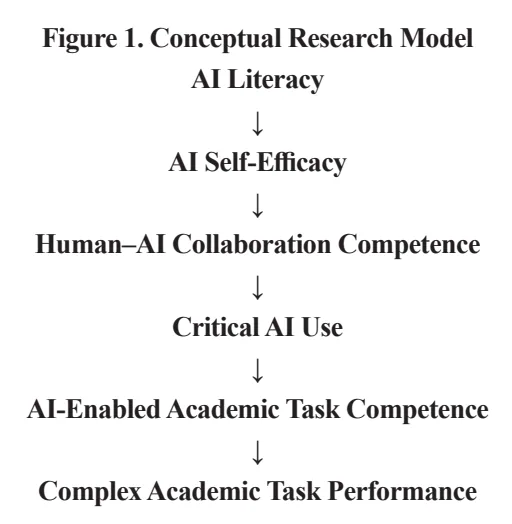
12. Conclusion
This study sought to clarify how faculty members in Vietnamese non-public universities develop the capability to leverage artificial intelligence for solving complex academic tasks in the global digital era. Rather than conceptualizing AI competence simply as access to or use of AI tools, the study approached the issue from the perspective of AIenabled academic capability and the collaborative relationship between humans and AI.
First, the study finds that the academic value of AI does not arise simply from faculty members' access to or use of AI. More importantly, value depends on how faculty members transform AI into a cognitive resource for addressing complex academic tasks. This process is conceptualized through the capability pathway: AI Literacy → AI Self-Efficacy → Human–AI Collaboration Competence → Critical AI Use → AI-Enabled Academic Task Competence → Complex Academic Task Performance. Within this pathway, AI literacy and AI self-efficacy provide essential foundations, but human–AI collaboration and critical AI use constitute important mechanisms through which technological potential can be translated into academic task capability.
Second, theoretically, the study shifts the conceptualization from "AI as Tool" toward "AI as Collaborative Cognitive Resource." Its central theoretical contribution is not simply to establish whether AI is useful, but to explain through which mechanisms AI generates academic value. The study introduces AI-Enabled Academic Task Competence, develops Human–AI Collaboration Competence, and incorporates Critical AI Use into the capabilitydevelopment pathway. In addition, Institutional AI Support is incorporated as a moderating factor, emphasizing that faculty AI capability is shaped not only by individual characteristics but also by the institutional environment in which AI-supported academic work takes place.
Third, from a practical perspective, universities should not focus exclusively on investing in AI tools or providing short-term training on how to use ChatGPT. Instead, they should develop an AI Capability Ecosystem and an AI Academic Competence Development Program through which faculty members can progress from AI Awareness → AI User → AI Practitioner → AI Collaborator → AI-Augmented Academic Professional. Institutional policies should simultaneously support infrastructure, professional development, technology access, information verification, AI ethics, academic integrity, and innovation in teaching and research.
The central conclusion of the study can therefore be stated at the mechanism level: the value of AI in academic work depends not merely on access to AI, but on lecturers' capacity to collaborate with, critically evaluate, and strategically integrate AI into complex academic tasks. Accordingly, the objective of AI transformation in higher education should not be to produce increasingly proficient "AI users," but to develop "AI-augmented academic professionals" who can combine human disciplinary expertise with AI-enabled cognitive capabilities while preserving human agency, critical thinking, and academic responsibility.
13. Limitations of the Study
Although this study proposes and empirically validates an integrated theoretical framework for developing lecturers' competence in leveraging artificial intelligence to address complex academic tasks, several limitations should be acknowledged:
First, the study employs a cross-sectional design, meaning that the data were collected at a single point in time. Consequently, the study cannot fully capture how faculty members' AI capabilities develop, stabilize, or change over time. Although the relationships among AI Literacy, AI Self-Efficacy, Human–AI Collaboration Competence, Critical AI Use, and AI-Enabled Academic Task Competence are theoretically structured as a developmental mechanism, a cross-sectional design limits the extent to which causal and temporal inferences can be established.
Second, self-report bias represents another limitation. Constructs such as AI Self-Efficacy, AI Literacy, and Critical AI Use may partly depend on participants' subjective perceptions. Perceived competence does not necessarily correspond to demonstrated competence in authentic academic tasks. Responses may therefore be affected by social desirability, recall limitations, or individual differences in self-assessment standards.
Third, the study is situated within the Vietnamese non-public higher education context. Institutional governance, technological resources, organizational culture, faculty development policies, and access to AI technologies may differ substantially across university systems and national settings. Accordingly, the generalizability of the findings beyond Vietnamese non-public universities should be interpreted with caution.
Fourth, the rapid evolution of Generative AI constitutes an important temporal limitation. New AI models, capabilities, interfaces, and human–AI interaction patterns are continuously emerging. Consequently, the AI-use behaviors and competencies observed at one point may evolve as
the technological environment changes. Moreover, differences among AI platforms-including their reasoning capabilities, accuracy, data-processing functions, multimodality, output controllability, and interaction design-may produce different effects on academic task performance. Future research should therefore avoid treating "AI" as a completely homogeneous technological category.
14. Directions for Future Research
Future studies should therefore adopt longitudinal designs to examine how faculty AI capability develops over time. Such designs could track the transition from AI Awareness → AI User → AI Practitioner → AI Collaborator → AI-Augmented Academic Professional, providing stronger evidence regarding how AI-related competencies are acquired, consolidated, and transformed into effective performance in complex academic tasks.
Future research should also incorporate experimental and task-based assessment approaches. Rather than relying exclusively on respondents' perceptions of their AI competence, researchers could assign authentic academic tasks—such as research design, literature synthesis, data analysis, instructional-material development,
academic writing, or complex scholarly problemsolving—with and without AI assistance. Objective indicators could include accuracy, reasoning quality, completion time, error-detection ability, sourceverification quality, and the improvement of final outputs.
Finally, cross-country comparative research could examine whether the proposed AIACDM framework remains robust across different higher education systems, cultures, institutional structures, and levels of technological development. A particularly promising research agenda would integrate Longitudinal + Experimental + Cross-country + Objective Performance Data. Such an integrated design would provide stronger evidence concerning causal mechanisms, cross-context validity, and actual academic performance, while also enabling researchers to distinguish the effects of individual capability, AI-platform characteristics, and institutional support conditions.
In summary, the next stage of research should move beyond simply expanding sample sizes toward measuring demonstrated AI capability in authentic academic settings. This represents an important transition from studying AI use to examining AI-enabled academic performance.
Tài liệu tham khảo
-
Akgun, S., & Greenhow, C. (2022). Artificial intelligence in education: Addressing ethical challenges in K–12 settings. AI and Ethics, 2, 431–440. DOI: https://doi.org/10.1007/s43681-021-00096-7
-
Amershi, S., Weld, D., Vorvoreanu, M., Fourney, A., Nushi, B., Collisson, P., Suh, J., Iqbal, S., Bennett, P. N., Inkpen, K., Chancellor, S., DeLine, R., & Horvitz, E. (2019). Guidelines for human–AI interaction. Proceedings of the 2019 CHI Conference on Human Factors in Computing Systems, 1–13. DOI: https://doi.org/10.1145/3290605.3300233
-
Baig, M. I., & Yadegaridehkordi, E. (2024). ChatGPT in higher education: A systematic literature review and research challenges. International Journal of Educational Research, 127, 102411.DOI: https://doi.org/10.1016/j.ijer.2024.102411
-
Bandura, A. (1997). Self-efficacy: The exercise of control. W. H. Freeman. https://books.google.com/books?id=e4jH9i1rjSAC
-
Bond, M., Khosravi, H., De Laat, M., Bergdahl, N., Negrea, V., Oxley, E., Pham, P., Chong, S. W., & Siemens, G. (2024). A meta systematic review of artificial intelligence in higher education: A call for increased ethics, collaboration, and
-
rigour. International Journal of Educational Technology in Higher Education, 21, 4.DOI: https://doi.org/10.1186/s41239-023-00436-z
-
Bùi, T. K. G., & Vũ, V. T. (2026). Chuyển đổi vai trò giảng viên trong kỷ nguyên trí tuệ nhân tạo: Từ người truyền đạt tri thức đến người kiến tạo năng lực học tập. Tạp chí Giáo chức Việt Nam, 237(K1), 217–220.DOI: https://vjol.info.vn/giaochuc/vi/article/view/143118/
-
Cabellos, B., de Aldama, C., & Pozo, J.-I. (2024). University teachers' beliefs about the use of generative artificial intelligence for teaching and learning. Frontiers in Psychology, 15. DOI: https://doi.org/10.3389/fpsyg.2024.1468900
-
Chan, C. K. Y. (2023). A comprehensive AI policy education framework for university teaching and learning. International Journal of Educational Technology in Higher Education, 20, 38.DOI: https://doi.org/10.1186/s41239-023-00408-3
-
Chan, C. K. Y., & Hu, W. (2023). Students' voices on generative AI: Perceptions, benefits, and challenges in higher education. International Journal of Educational Technology in Higher Education, 20, 43.DOI: https://doi.org/10.1186/s41239-023-00411-8
-
Chen, L., Chen, P., & Lin, Z. (2020). Artificial intelligence in education: A review. IEEE Access,
-
8, 75264–75278.DOI: https://doi.org/10.1109/ ACCESS.2020.2988510
-
Compeau, D. R., & Higgins, C. A. (1995). Computer self-efficacy: Development of a measure and initial test. MIS Quarterly, 19(2), 189–211.DOI: https://doi.org/10.2307/249688
-
Cotton, D. R. E., Cotton, P. A., & Shipway, J. R. (2024). Chatting and cheating: Ensuring academic integrity in the era of ChatGPT. Innovations in Education and Teaching International, 61(2), 228–239.DOI: https://doi.org/10.1080/14703297.2023.2190148
-
Crompton, H., & Burke, D. (2023). Artificial intelligence in higher education: The state of the field. International Journal of Educational Technology in Higher Education, 20, 22. DOI: https://doi.org/10.1186/s41239-023-00392-8
-
Davis, F. D. (1989). Perceived usefulness, perceived ease of use, and user acceptance of information technology. MIS Quarterly, 13(3), 319–340.DOI: https://doi.org/10.2307/249008
-
Dellermann, D., Ebel, P., Söllner, M., & Leimeister, J. M. (2019). Hybrid intelligence. Business & Information Systems Engineering, 61, 637–643. DOI: https://doi.org/10.1007/s12599-019-00595-2
-
Dwivedi, Y. K., Kshetri, N., Hughes, L., Slade, E. L., Jeyaraj, A., Kar, A. K., Baabdullah, A. M., Koohang, A., Raghavan, V., Ahuja, M., Albanna, H., Albashrawi, M. A., Al-Busaidi, A. S., Balakrishnan, J., Barlette, Y., Basu, S., Bose, I., Brooks, L., Buhalis, D., ... Wright, R. (2023). "So what if ChatGPT wrote it?" Multidisciplinary perspectives on opportunities, challenges and implications of generative conversational AI for research, practice and policy. International Journal of Information Management, 71, 102642. DOI: https://doi.org/10.1016/j.ijinfomgt.2023.102642
-
Dương, V. Đ. (2025). Chuyển đổi số giáo dục đại học: Yêu cầu năng lực số và những thách thức đối với đội ngũ quản lí và giảng viên. Tạp chí Giáo dục, 25(Đặc biệt 9), 49–54. https://tcgd.tapchigiaoduc.edu.vn/index.php/tapchi/article/view/4188
-
Ertmer, P. A., & Ottenbreit-Leftwich, A. T. (2010). Teacher technology change: How knowledge, confidence, beliefs, and culture intersect. Journal of Research on Technology in Education, 42(3), 255–284.DOI: https://doi.org/10.1080/15391523. 2010.10782551
-
Farrokhnia, M., Banihashem, S. K., Noroozi, O., & Wals, A. (2024). A SWOT analysis of ChatGPT: Implications for educational practice and research. Innovations in Education and Teaching International, 61(3), 460–474.DOI: https://doi.org/10.1080/14703297.2023.2195846
-
Hoàng, V. H., & Nguyễn, T. K. D. (2026). Exploring
-
ChatGPT literacy of English language teachers in Vietnamese higher education. TNU Journal of Science and Technology, 231(4), 308–315. DOI: https://doi.org/10.34238/tnu-jst.13512
-
Holden, H., & Rada, R. (2011). Understanding the influence of perceived usability and technology self-efficacy on teachers' technology acceptance. Computers & Education, 57(3), 2352–2361.DOI: https://doi.org/10.1016/j.compedu.2011.05.003
-
Kasneci, E., Sessler, K., Küchemann, S., Bannert, M., Dementieva, D., Fischer, F., Gasser, U., Groh, G., Günnemann, S., Hüllermeier, E., Krusche, S., Kutyniok, G., Michaeli, T., Nerdel, C., Pfeiffer, F., Poquet, O., Sailer, M., Schmidt, A., Seidel, T., ... Kasneci, G. (2023). ChatGPT for good? On opportunities and challenges of large language models for education. Learning and Individual Differences, 103, 102274. DOI: https://doi.org/10.1016/j.lindif.2023.102274
-
Koehler, M. J., Mishra, P., & Cain, W. (2013). What is technological pedagogical content knowledge (TPACK)? Journal of Education, 193(3), 13–19. DOI: https://doi.org/10.1177/002205741319300303
-
Labadze, L., Grigolia, M., & Machaidze, L. (2023). Role of AI chatbots in education: Systematic literature review. International Journal of Educational Technology in Higher Education, 20, 56.DOI: https://doi.org/10.1186/s41239-023-00426-1
-
Lintner, T. (2024). A systematic review of AI literacy scales. npj Science of Learning, 9, 50. DOI: https://doi.org/10.1038/s41539-024-00264-4
-
Liu, Q., Geertshuis, S., & Grainger, R. (2020). Understanding academics' adoption of learning technologies: A systematic review. Computers & Education, 151, 103857. DOI: https://doi.org/10.1016/j.compedu.2020.103857
-
Long, D., & Magerko, B. (2020). What is AI literacy? Competencies and design considerations. Proceedings of the 2020 CHI Conference on Human Factors in Computing Systems, 1–16. DOI: https://doi.org/10.1145/3313831.3376727
-
Lữ, Q. V., Nguyễn, N. C. L., Nguyễn, N. P. T., & Nguyễn, M. T. (2026). Năng lực thiết kế học tập thích ứng với trí tuệ nhân tạo của giảng viên: Nghiên cứu tại Đại học Cần Thơ. Tap chí Giáo dục, 26(Đặc biệt 1), 329–334. DOI: https://tcgd.tapchigiaoduc.edu.vn/index.php/tapchi/article/view/5676
-
Mah, D.-K., & Groß, N. (2024). Artificial intelligence in higher education: Exploring faculty use, self-efficacy, distinct profiles, and professional development needs. International Journal of Educational Technology in Higher Education, 21, 58.DOI: https://doi.org/10.1186/s41239-024-00490-1
-
Mishra, P., & Koehler, M. J. (2006). Technological
-
pedagogical content knowledge: A framework for teacher knowledge. Teachers College Record, 108(6), 1017–1054. DOI: https://doi.org/10.1111/j.1467-9620.2006.00684.x
-
Ng, D. T. K., Leung, J. K. L., Chu, K. W. S., & Qiao, M. S. (2021). Conceptualizing AI literacy: An exploratory review. Computers and Education: Artificial Intelligence, 2, 100041. DOI: https://doi.org/10.1016/j.caeai.2021.100041
-
Nguyễn, T. V. N. (2025). Nghiên cứu tình huống về việc sử dụng ChatGPT để điệu chỉnh độ khó của tài liệu đọc chuyên ngành bằng tiếng Anh. Tạp chí Nghiên cứu nước ngoài, 42(4), 97–110.DOI: https://doi.org/10.63023/2525-2445/jfs.ulis.5666
-
Ouyang, F., & Jiao, P. (2021). Artificial intelligence in education: The three paradigms. Computers and Education: Artificial Intelligence, 2, 100020. DOI: https://doi.org/10.1016/j.caeai.2021.100020
-
Parasuraman, R., Sheridan, T. B., & Wickens, C. D. (2000). A model for types and levels of human interaction with automation. IEEE Transactions on Systems, Man, and Cybernetics—Part A: Systems and Humans, 30(3), 286–297.DOI: https://doi.org/10.1109/3468.844354
-
Phan, T. M. T., & Tiêu, B. S. (2023). Nâng cao năng lực của giảng viên đại học thời chuyển đổi số. Tạp chí Khoa học Trường Đại học Quốc tế Hồng Bàng, 25, 139–146. DOI: https://doi.org/10.59294/HIUJS.25.2023.513
-
Shneiderman, B. (2020). Human-centered artificial intelligence: Reliable, safe & trustworthy. International Journal of Human-Computer Interaction, 36(6), 495–504. DOI: https://doi.org/10.1080/10447318.2020.1741118
-
Sun, Y., & Liu, F. (2026). The impact of an AI Digital Teacher on human-AI collaborative learning in higher education. Smart Learning Environments, 13, 30. DOI: https://doi.org/10.1186/s40561-026-00454-0
-
Thủ tướng Chính phủ. (2020). Quyết định số 749/ QĐ-TIg ngày 03/6/2020 phê duyệt Chương trình Chuyển đổi số quốc gia đến năm 2025, định hướng đến năm 2030. https://vanban.chinhphu. vn/?docid=200163&pageid=27160&tagid=7& type=1
-
Thủ tướng Chính phủ. (2021). Quyết định số 127/ QĐ-TTg ngày 26/01/2021 ban hành Chiến lược quốc gia về nghiên cứu, phát triển và ứng dụng trí tuệ nhân tạo đến năm 2030. https://chinhphu. vn/default.aspx?docid=202565&pageid=27160
-
Thủ tướng Chính phủ. (2022). Quyết định số 131/QĐ-TTg ngày 25/01/2022 phê đuyệt Đề án "Tăng cường ứng dụng công nghệ thông tin và chuyển đối số trong giáo dục và đào tạo giai đoạn 2022–2025, định hướng đến năm 2030". https://congbao.chinhphu.vn/van-ban/quyet-dinh-so-131-qd-ttg-36755/39785.htm
-
Tlili, A., Shehata, B., Adarkwah, M. A., Bozkurt,
-
A., Hickey, D. T., Huang, R., & Agyemang, B. (2023). What if the devil is my guardian angel: ChatGPT as a case study of using chatbots in education. Smart Learning Environments, 10, 15.DOI: https://doi.org/10.1186/s40561-023-00237-x
-
UNESCO. (2024). AI competency framework for teachers. UNESCO. DOI: https://doi.org/10.54675/ZJTE2084
-
Venkatesh, V., Morris, M. G., Davis, G. B., & Davis, F. D. (2003). User acceptance of information technology: Toward a unified view. MIS Quarterly, 27(3), 425–478. DOI: https://doi.org/10.2307/30036540
-
Wang, H., Dang, A., Wu, Z., & Mac, S. (2024). Generative AI in higher education: Seeing ChatGPT through universities' policies, resources, and guidelines. Computers and Education: Artificial Intelligence, 7, 100326. DOI: https://doi.org/10.1016/j.caeai.2024.100326
-
Wang, S., Wang, F., Zhu, Z., Wang, J., Tran, T., & Du, Z. (2024). Artificial intelligence in education: A systematic literature review. Expert Systems with Applications, 252, 124167. DOI: https://doi.org/10.1016/j.eswa.2024.124167
-
Yang, Y., Xia, Q., Liu, C., & Chiu, T. K. F. (2025). The impact of TPACK on teachers' willingness to integrate generative artificial intelligence (GenAI): The moderating role of negative emotions and the buffering effects of need satisfaction. Teaching and Teacher Education, 154, 104877.DOI: https://doi.org/10.1016/j. tate.2024.104877
-
Yan, L., Sha, L., Zhao, L., Li, Y., Martinez-Maldonado, R., Chen, G., Li, X., Jin, Y., & Gašević, D. (2024). Practical and ethical challenges of large language models in education: A systematic scoping review. British Journal of Educational Technology, 55(1), 90–112. DOI: https://doi.org/10.1111/bjet.13370
-
Zawacki-Richter, O., Marín, V. I., Bond, M., & Gouverneur, F. (2019). Systematic review of research on artificial intelligence applications in higher education—Where are the educators? International Journal of Educational Technology in Higher Education, 16, 39. DOI: https://doi.org/10.1186/s41239-019-0171-0
-
Zhai, X. (2024). Transforming teachers' roles and agencies in the era of generative AI: Perceptions, acceptance, knowledge, and practices. Journal of Science Education and Technology.DOI: https://doi.org/10.1007/s10956-024-10174-0
-
Zhao, Y., Pinto Llorente, A. M., & Sánchez Gómez, M. C. (2021). Digital competence in higher education research: A systematic literature review. Computers & Education, 168, 104212.DOI: https://doi.org/10.1016/j.compedu.2021.104212
PHÁT TRIỂN NĂNG LỰC KHAI THÁC HIỆU QUẢ TRÍ TUỆ NHÂN TẠO CỦA GIẢNG VIÊN KHI GIẢI QUYẾT CÁC NHIỆM VỤ HỌC THUẬT PHÚC TẠP: NGHIÊN CỨU TẠI CÁC TRƯỜNG ĐẠI HỌC NGOÀI CÔNG LẬP VIỆT NAM TRONG KỶ NGUYÊN SỐ TOÀN CẦU
Ngô Quang Son*
Email: ngoquangson2018@gmail.com
ORCID iD: https://orcid.org/0000-0003-3120-034X
Bùi Thị Hương
Trung tâm Hỗ trơ Phát triển Giáo dục hòa nhập
Thiên Thần, Thành phố Hồ Chí Minh
Email: vientamlyungdung@gmail.com
Nguyễn Thị Thùy Anh
Email: thuyanh261nn@gmail.com
Pham Thu Hà
Khoa Sau Đai học, Trường Đai học Nguyễn Trãi
Email: hathu30789@gmail.com
Cao Thanh Long
Viện Đào tạo từ xa, Trường Đại học Nguyễn Trãi
Email: caothanhlong1107@gmail.com
Lê Hà Trang
Khoa Tài chính – Ngân hàng, Trường Đại học
Nguyễn Trãi
Email: lehatrang2809@gmail.com
Trịnh Vân Trang
Khách san Grand Plaza Hà Nôi
Email: trinhvantrang.1893@gmail.com
Duong Thanh Nga
Trường Cao đẳng Thương mại và Du lịch Hà Nội
Email: duongnga1980@gmail.com
Tóm tắt:
Trí tuệ nhân tạo (AI), đặc biệt là AI tạo sinh, đáng làm thay đổi sâu sắc bản chất của công việc học thuật trong giáo dục đại học, từ giảng dạy, nghiên cứu, phân tích dữ liệu đến viết học thuật và giải quyết các vấn đề có mức độ phức tạp cao. Tuy nhiên, khả năng tiếp cận và sử dụng AI không mặc nhiên chuyển hóa thành năng lực khai thác AI hiệu quả. Khoảng cách giữa "sử dụng AI" và "cộng tác hiệu quả với AI" đang trở thành một vấn đề quan trọng trong phát triển đội ngũ giảng viên.
Nghiên cửu nhằm xác định và kiểm định các yếu tố hình thành năng lực khai thác AI của giảng viên khi giải quyết các nhiệm vụ học thuật phức tạp tại các trường đại học ngoài công lập Việt Nam. Nghiên cứu tập trung làm rõ vai trò của năng lực hiểu biết về AI, tự hiệu quả AI, năng lực cộng tác Người–AI và sử dụng AI có phản biện; đồng thời xem xét vai trò
điều tiết của hỗ trơ AI từ tổ chức.
Nghiên cứu được thiết kế theo phương pháp hỗn hợp tuần tự. Giai đoạn định tính sử dụng phỏng vấn chuyên gia và/hoặc Delphi để phát triển, điều chỉnh và xác nhận các cấu trúc đo lường. Giai đoạn định lượng tiến hành khảo sát giảng viên tại các trường đại học ngoài công lập ở Việt Nam. Dữ liệu được phân tích bằng mô hình phương trình cấu trúc PLS-SEM hoặc CB-SEM nhằm kiểm định các tác động trực tiếp, trung gian và điều tiết trong mô hình nghiên cứu.
Nghiên cứu hướng tới xác định cơ chế mà qua đó Kiến thức về AI và năng lực tự thân của AI được chuyển hóa thành Năng lực hợp tác giữa con người và AI, Ứng dụng AI mang tính phê phán và năng lực thực hiện nhiệm vụ học thuật được hỗ trợ bởi AI, từ đó nâng cao khả năng giải quyết các nhiệm vụ học thuật phức tạp của giảng viên.
Nghiên cứu đề xuất mô hình Phát triển năng lực học thuật với sự hỗ trợ của AI làm cơ sở cho phát triển đội ngũ giảng viên trong kỷ nguyên số, đồng thời cung cấp hàm ý quản trị cho các trường đại học ngoài công lập về đào tạo năng lực AI, xây dựng hệ sinh thái hỗ trợ AI và thúc đẩy sử dụng AI có trách nhiệm, phản biện và định hướng hiệu quả học thuật.
Từ khóa: Trí tuệ nhân tạo; Trí tuệ nhân tạo tạo sinh; Năng lực hiểu biết về trí tuệ nhân tạo; Năng lực cộng tác Người—Trí tuệ nhân tạo; Năng lực học thuật được hỗ trợ bởi trí tuệ nhân tạo; Nhiệm vụ học thuật phức tạp; Phát triển năng lực giảng viên; Giáo dục đại học ngoài công lập.
Nguyễn Công Tý
Bệnh viện Phụ sản Trung Ương
Email: tringuyennhg@gmail.com
Nguyễn Công Quân
Trường Đại học Đại Nam
ROR ID: https://ror.org/0031x3y66
Email: ncquan@gmail.com
Nguyễn Thị Ngọc Vân
Trường Đại học Intracom
Email: vanhbu@gmail.com
Lê Mạnh Hùng
Email: hunglemanh1905@gmail.com
Lê Thị Ly Na
Sở Giáo dục và Đào tạo Lâm Đồng
Email: lynavn89@gmail.com
Lịch sử bài báo
Ngày nhận bài: Ngày phản biện: Ngày tác giả sửa: Ngày duyệt đăng: 30/6/2026 30/7/2026 15/9/2026 20/9/2026
Ngày phát hành: 30/9/2026
DOI: https://doi.org/10.64223/tvj.p2026.v2.i7.a129
JInternational Classification Codes:
JEL: I23; O33; M15; D83.
UNESCO: 5802.04; 5803.04; 5801.07. OECD FoR: 05.03; 05.03.02; 01.02.03.