Anxiety, enjoyment, and boredom in language learning amongst junior secondary students in rural China: How do they contribute to L2 achievement?
Nguồn và giấy phép
- Tên bài
- Anxiety, enjoyment, and boredom in language learning amongst junior secondary students in rural China: How do they contribute to L2 achievement?
- Tác giả
- Chengchen Li, Li Wei
- Tạp chí
- Studies in Second Language Acquisition, 2022
- DOI
- 10.1017/s0272263122000031
- Giấy phép
- CC BY 4.0
Đã chuyển định dạng từ bản gốc; nội dung không thay đổi.
Xem bản gốc
RESEARCH ARTICLE
Anxiety, enjoyment, and boredom in language learning amongst junior secondary students in rural China: How do they contribute to L2 achievement?
Chengchen Li¹ and Li Wei²*
¹Huazhong University of Science and Technology, Wuhan, China; ²UCL Institute of Education, University College London, 20 Bedford Way, London WC1H 0AL, UK.
(Received 17 February 2021; Revised 15 December 2021; Accepted 19 December 2021)
Abstract
Building on the control-value theory, the present study examined the independent and joint predictive effects of three emotions—enjoyment, anxiety, and boredom—on L2 achievement over time. The participants of the study were a group of junior secondary English learners in rural China, a population that has hitherto never featured in L2 learning research. Questionnaire data and achievement data were collected at four different time points (Time 1–Time 4: T1–T4) from a large sample of 954 learners. Structural equation modeling results show that: (a) the three emotions at T1 predicted English achievement at T2 (one week after T1) and T3 (five weeks after T1) independently, while only enjoyment predicted achievement at T4 (nine weeks after T1); (b) when combined, enjoyment was the strongest and most enduring predictor across T2–T4, followed by anxiety predicting achievement at T2–T3 negatively, while boredom completely lost its predictive power across T2–T4.
Introduction
L2 learning is a multifaceted phenomenon whose process and outcome are greatly affected by learner-internal and learner-external factors. Recent years have witnessed a growing interest in sociopsychological factors in L2 learning. But empirical evidence on their effects on L2 achievements is still fairly limited. Among the psychological factors, adult L2 emotions have been extensively studied (e.g., anxiety: Horwitz et al., 1986; enjoyment: Dewaele & MacIntyre, 2014; boredom: Li, 2021a; Pawlak et al., 2020b). However, how these emotions are connected with achievements in L2 remains largely unanswered. The present study aims to address the links between anxiety, enjoyment, and boredom, and English achievements of 954 junior secondary English-as-a-Foreign-Language (EFL) students in rural China. We adopt a control-value theory approach to
© The Author(s), 2022. Published by Cambridge University Press. This is an Open Access article, distributed under the terms of the Creative Commons Attribution licence (http://creativecommons.org/licenses/by/4.0), which permits unrestricted re-use, distribution and reproduction, provided the original article is properly cited.
Corresponding author. E-mail: li.wei@ucl.ac.uk
examine the independent and joint predictive effects of the three emotions on L2 achievements over time. We are particularly concerned with the durability of the predictive power of these emotions on L2 achievements.
Emotions and Achievement
We chose to focus on three emotions that have been shown to play a significant role in language learning: anxiety, enjoyment, and boredom.
Foreign Language (Classroom) Anxiety
Foreign language (classroom) anxiety (FLCA) reflects three representative anxieties, namely, communication apprehension, test anxiety, and fear of negative evaluation (Horwitz, 2017). Whilst earlier studies argued that some anxieties may have a facilitating effect on performance (Alpert & Haber, 1960; Scovel, 1978), recent studies revealed an overall negative correlation between FLCA and achievement (Botes et al., 2020; Teimouri et al., 2019; Zhang, 2019). Horwitz (2017) recently also argued that there is a curvilinear rather than linear relationship between anxiety and achievement. All these studies point to the need for more empirical evidence across different groups. In addition, it remains unclear how durable the effect of anxiety on achievement is, necessitating longitudinal investigations.
Foreign Language Enjoyment
Foreign language enjoyment (FLE) is described as"enjoyment, fun, interest, and lack of boredom" (Dewaele & MacIntyre, 2014, p. 242) experienced in specific relation to the L2 environment. FLE research flourishes with the positive psychology movement in the field of SLA. Supporting the holistic view on an individual's diverse emotions (Fredrickson, 2003; MacIntyre & Gregersen, 2012), Dewaele and MacIntyre (2014) suggest that FLE is the positive counterpart of FLCA. FLE occurs when an individual's psychological needs are satisfied and it is a key component of flow experience, which is crucial for language learning and development (Dewaele & MacIntyre, 2014). Most of the existing FLE studies look at how enjoyment arises (Dewaele et al., 2018; Li et al., 2018), and how it is linked to a multitude of learner-internal factors (e.g., age, onset age of FL learning, relative FL standing, self-perceived FL proficiency, and FL attitude) as well as learner-external factors (e.g., teacher style, teacher personality, teacher FL use, and classroom environment) (Dewaele et al., 2019; Li et al., 2021b). Few studies have examined the exact contribution of FLE to L2 achievement. Dewaele and Alfawzan (2018) found among two samples of L2 learners in London (age range: 12–18) and Saudi Arabia (age range: 18–40) that FLE predicted FL achievement positively, while FLCA predicted FL achievement negatively and that the predictive effects of FLE in the two samples were larger than those of FLCA. In a study of Chinese senior secondary students (mean age = 16.61, SD = .75), Li et al. (2020) found that FLCA was negatively related to achievement while FLE was positively related to achievement and that the negative effect of FLCA outweighed that of FLE. The results seem to suggest that the patterns between emotions and achievement may vary across different contexts.
Foreign Language Learning Boredom
Boredom, a newly emerging construct in SLA, is capturing more and more scholarly attention. Unlike anxiety or enjoyment, boredom is more inconspicuous. Based on boredom research in general educational contexts (Goetz & Hall, 2014; Tze et al., 2016), Li et al. (2021a) proposed the construct of foreign language learning boredom (FLLB) and conceptualized it as a three-dimensional achievement emotion following the control-value theory (Pekrun, 2006) that we will turn to later. Existing studies have identified wide-ranging learner-internal factors (e.g., control appraisal, value appraisal, achievement goal, L2 proficiency, and physical state) (Dewaele & Li, 2021; Li 2021b; Li & Dewaele, 2020) and learner-external factors (e.g., task difficulty, teacher personality, classroom atmosphere, teaching style, and class organization) (Derakhshan et al., 2021; Kruk, 2022; Pawlak et al., 2020a) accounting for FLLB. Li et al. (2021a) revealed that FLLB is characterized by various negative feelings or/and symptoms (e.g., inattention, disengagement, desire to escape, mind blankness, frustration, dislike, tiredness, restlessness, agitation, lack of meaning and goal, unhappiness, distorted time perception, and sadness). These, in turn, should undermine overall L2 achievement. However, it has remained underexplored empirically.
Anxiety, Enjoyment, Boredom, and Their Links with Achievement
General educational research has connected the three emotions and examined how they are linked with learning achievements over time. Westphal et al. (2018), for example, examined enjoyment, anxiety, and boredom experienced in mathematics and Germanas-first-language classes, finding significant negative relationships between enjoyment and the two negative emotions—anxiety and boredom, and a positive relationship between the two negative emotions in both subjects. Raccanello et al. (2019) explored the three emotions of 767 second-grade and fourth-grade students in relation to German-as-first-language and mathematics, finding that enjoyment was a positive predictor of achievement in both subjects and their subdomains, while boredom and anxiety were negative predictors. In another four-wave longitudinal study, Putwain et al. (2018) examined the enjoyment and boredom experiences of primary students in England and the data showed that enjoyment was positively linked to mathematics achievement, while boredom was linked negatively. However, such investigations are just starting and it remains to be further explored whether the findings obtained apply to other educational contexts.
In SLA, how these emotions are combined to exert effects on L2 achievements over time is an issue that has not been investigated. As MacIntyre and Gregersen (2012) argued, the daily emotional schema of L2 learners reflects the coexistence of positive emotions and negative emotions. It is needed to investigate how different emotions coexist in L2 learning. In addition, as MacIntyre (2017) argued, a contextualized approach is required to examine emotions like anxiety. That is, emotion should be situated among a host of interacting factors because it does not exist in a vacuum, instead, it is continuously interacting with wide-ranging individual difference factors to affect language learning and development. The present study situates the three emotions among each other, tapping how they are interconnected and predict achievements at different time points. Such an investigation is important in that the collective relationship of these emotions and subsequent achievements contribute to an in-depth understanding of the mechanism underlying successful L2 learning. The findings may also shed insights into implementing emotional interventions in L2 settings and predicting how durable the achievement effects of such interventions would be.
The Control-Value Theory: Achievement Emotions and Achievement
We adopt the control-value theory, which seeks to provide a conceptual framework to explain the origins, antecedents, and outcomes of achievement emotions (Pekrun, 2006). The control-value theory posits that achievement emotions are organized in a three-dimensional taxonomy: object focus, valence, and activation. The object focus of achievement emotions pertains to the differentiation of activity-related emotions (e.g., enjoyment, boredom) and outcome-related emotions (e.g., anxiety, hope). In terms of valence, achievement emotions could be grouped into positive (pleasant) emotions (e.g., enjoyment, pride) and negative (unpleasant) emotions (e.g., anxiety, sadness). The dimension of activation distinguishes physiologically activating (e.g., enjoyment, anxiety) emotions from deactivating emotions (e.g., boredom, relaxation) (Pekrun & Perry, 2014). Following this taxonomy, anxiety, enjoyment, and boredom, three prevalent achievement emotions under discussion, could be understood as (a) negative, activating, and outcome related; (b) positive, activating, and activity related; and (c) negative, deactivating, and activity related, respectively.
The control-value theory assumes that achievement emotions influence learning and learning achievement through impacting their underlying cognitive mechanisms (e.g., working memory, decision making, information processing, and problem solving) and motivational mechanisms (Pekrun & Perry, 2014). The theory implies that emotions have profound effects on academic activities and resulting achievement. However, it refutes the presumed equation: Positive emotions mean positive achievement effects and negative emotions mean negative effects. For example, positive deactivating emotions like relief may induce unrealistic appraisals, foster superficial information processing, reduce motivation to pursue challenging academic goals, and thus lead to lazy thinkers, which may further impair overall achievement. Negative activating effects, such as anxiety, shame, and anger, are expected to exert either positive or negative effects on motivational mechanisms and cognitive mechanisms underlying learning and achievement. For example, anxiety could be either facilitative or debilitative (Scovel, 1978). These coalesce to point to the need for a more nuanced understanding of and more empirical investigations of the relationship between achievement emotions and subsequent achievements.
Whilst the complexity of the effects of achievement emotions has been addressed by the control-value theory, little attention has been paid to the duration of the achievement effects. We want to find out in the present study: Whether the effects, be positive or negative, will fade away or snowball over time? And how long will the achievement effect last?
Research questions
The research questions of the present study are therefore:
-
- How do anxiety, enjoyment, and boredom (Time 1: T1) predict subsequent foreign language achievements (T2–T4) independently?
-
- How are the three emotions (T1) combined and predict subsequent foreign language achievements (T2–T4) jointly?
Following the control-value theory and based on relevant empirical literature in SLA and general educational psychology (Dewaele et al., 2018; Li et al., 2018; Raccanello et al., 2019), we proposed the following hypotheses (Hs):
H1: Anxiety and boredom will be negatively related to subsequent FL achievements, while enjoyment will be positively linked, and the predictive effects of the three emotions will decline over time;
H2: The three emotions will be significantly related to each other;
H3: The three emotions will predict subsequent FL achievements jointly and distinctively, and their predictive effects will decline over time (T2–T4).
Methodology
Participants and Context
The present study focuses on EFL learners from rural China, a population that has hardly ever featured in SLA studies. A convenience sampling was adopted. All the participants were from a junior secondary school located in a small county in Anhui Province. A total of 1,197 (96.92 % of 1,235) students from 26 intact classes in Year 1 participated in the large project where the current study was nested within. For the current study, the final sample consisted of 954 (79.69 % of 1,197) participants who provided complete responses in the questionnaire survey (background information and three emotion scales) and participated in the three subsequent English tests. There were 358 (37.53 %) female participants and 596 (62.47 %) male participants. Their mean age was 13 (SD = .81), ranging from 11 to 17.
The participating school was a private one. All the participants were from Han ethnic group. They all spoke local dialect and Mandarin and learned English as their only foreign language. None of them had the experience of traveling or studying abroad. The onset of the age when they started to learn English ranged from 3 to 17 years old. All the participants were instructed in English using the same textbook and following the same curriculum. There were 12 units in the textbook. During each week, there were seven 45-minute sessions for English instruction arranged in the daytime (06:35–11:10, and 14:10–17:25) and three 45-minute sessions for English assignments and assignment feedback in the night (18:00–20:50). There was a quiz for each unit, a monthly test, a midterm test, and a final test, all of which last for two hours with a full score of 120.
A total of 43.92% (419/954) parents of the participants worked around the home, 27.88% (266/954) parents worked in distant urban areas, 25.68% (245/954) fathers worked in distant urban areas with the mothers working or staying around the home, and 2.52% (24/954) mothers worked in distant urban areas with the fathers working or staying around the home. Notably, only 15.83 % (151/954) of the students from four classes lived with their parents and 84.14% (803/954) were boarding students. All the students had half a day for rest on Sundays and two days for rest on subsequent Saturdays and Sundays. In other words, they only had two-day weekends every two weeks. For all boarding students, they were only allowed to go home during the weekends when both Saturdays and Sundays were for rest.
Instruments
The composite questionnaire consisted of two sections for main variables (the three emotional variables: anxiety, enjoyment, and boredom) and potential covariates (background information including students' age, gender, social-economic status, and the onset age of learning English), respectively.
Anxiety
Anxiety was assessed using a short version of the Foreign Language Classroom Anxiety Scale(FLCAS) (Horwitz et al., 1986). The shortened version consists of eight items that were extracted from the original 33-item FLCAS by Dewaele and MacIntyre (2014). The items revolve around anxiety-associated physical symptoms, nervousness, and lack of confidence in relation to L2 learning. The items are responded to on a five-point Likert scale, ranging from 1 (strongly disagree) to 5 (strongly agree). An example item is "I always feel that the other students speak English better than I do." There were two reverse-coded items. In the current study, the first confirmatory factor analysis (CFA) results revealed low factor loadings for the two reverse-coded items (i.e., 0.24 and –0.01), and thus they were removed. CFA was further performed and the results indicated that the model yielded a good fit to the data (CFI = .99, TLI = .98, RMSEA = .07). The Cronbach's alpha coefficient for the six-item scale was .91.
Enjoyment
Enjoyment was assessed with the Chinese Version of Foreign Language Enjoyment Scale (CFLES) validated by Li et al. (2018) among 1,718 Chinese senior secondary school students. The 11-item scale is a modified version of the Foreign Language Enjoyment Scale originally developed by Dewaele and MacIntyre (2014) and validated in an international sample of 1,742 L2 learners. The CFLES includes three subscales: FLE-Private (5 items; e.g., "I don't get bored in English class."), FLE-Teacher (3 items; e.g., "The English teacher is friendly.") and FLE-Atmosphere (3 items; e.g., "There is a good atmosphere in the class."). Response options reflect a five-point Likert scale ranging from 1 (strongly disagree) to 5 (strongly agree). In the current study, CFA was performed to test the three-factor model of the CFLES. The results indicated the model yielded a good fit to the data for the scale (CFI = 1.000, TLI = 1.010, RMSEA = .00). The Cronbach's alpha coefficient for the CFLES was .95.
Boredom
Boredom was assessed with the Foreign Language Learning Boredom Scale (FLLBS). The FLLBS was developed and validated among more than 3,000 Chinese university students by Li et al. (2021). It includes 32 items measuring seven subscales: (a) Foreign Language Class Boredom (8 items; e.g., "The English class bores me"); (b) Underchallenging Task Boredom (5 items; e.g., "So many similar types of (English) exercises make me lose interest"); (c) PowerPoint Presentation Boredom (3 items; e.g., "Reading from the script in the PPT slides bores me"); (d) Homework Boredom (4 items; e.g., "I get bored of too much English homework"); (e) Teacher-dislike Boredom (4 items; e.g., "The English teacher is uninteresting, so the English class is dull"); (f ) General Learning Trait Boredom (5 items; e.g., "I'm always bored when I study"); and (g) Overchallenging or Meaningless Task Boredom (3 items; e.g., "If I cannot understand classmates' presentations, I become really bored"). The items are responded to on a five-point Likert scale, ranging from 1 (strongly disagree) to 5 (strongly agree). In the current study, CFA was performed to test the seven-factor model of the FLLBS. The results indicated the model yielded a good fit to the data (χ 2 (df)= 69.90 (9), CFI=.99, TLI=.98, RMSEA=.08). The Cronbach's alpha coefficient for the FLLBS was as high as .98.
English Language Achievement
Foreign language achievement was operationalized as English test scores, collected in three monthly English exams held in March, April, and May. The tests were the same in terms of their format, structure, and requirement. The total score was 120 points and there were five parts including Listening (20 points for 20 items), Vocabulary and Grammar (30 points for 30 items), Reading Comprehension (45 points for 25 items), Blank Filling (5 points for three items), and Writing (20 points for a 60–80-word essay). The time limit was 120 minutes. The internal reliability for the three tests were .93, .91, and .92, respectively.
Covariates
Students' age, gender (1 = male, 2 = female), socioeconomic status (SES) data, and the onset age of learning English were also collected in the composite questionnaire as covariates. The education levels of participants' parents and monthly family income were used as our indicators of family SES. The education levels were rated on a scale from 1 (never attended school) to 7 (doctoral degree), and the monthly family income was rated on a scale from 1 (< 3,000 RMB) to 7 (>30,000 RMB). Following the procedures in previous studies (e.g., Zhang et al., 2019), the scores of participants' both parents' education levels and monthly family income were standardized by transforming them into z-scores. The index SES was the average score of the three standardized variables.
Procedure and Ethical Considerations
The study was supported by National Social Science Foundation in China, approved by the two institutions of the authors, and well supported by the local Education Bureau at the municipal level and its subordinate education department at the county level. We informed the school principal, headteachers, students, and their parents (other guardians like grandparents) of the nature, purpose, procedure, the approximate duration of the whole project, and data confidentiality. We obtained 1,197 out of 1,235 (96.92 %) written consent forms from student guardians.
The questionnaire survey was conducted in the middle of March (T1: Time 1). The questionnaire was uploaded to the most popular online questionnaire server https://www.wjx.cn/ in China. The participants were required to fill in the online questionnaire in one of their computer classes (for students in Year 1, there were two 45-minute computer classes each week). Those students whose guardians had not signed the consent forms were assigned other classroom exercise.
The three sets of English test scores were provided at Time 2 (one week after T1), Time 3 (five weeks after T1), and Time 4 (nine weeks after T1), respectively. A variety of stationery was rewarded to the participants for their cooperation in the whole project. Before data analysis, all identifying information had been removed. Pseudoabbreviations were created for the participants.
Data Analysis
Before statistical analyses, we first dealt with the issues of outliers. No missing values were identified because the questionnaire was administered online and forced choices were required for all items in the questionnaire. Second, we calculated descriptive statistics (means and standard deviations), normality tests, and correlation analyses for the variables under discussion using SPSS 21.0. Third, the measurement model was evaluated using Mplus 8.3. The model featured three indicators of FLE, six indicators of FLCA, and seven indicators of FLLB. Lastly, structural models were conducted using Mplus 8.3. We first individually examined the predictive roles of FLE, FLCA, and FLLB at T1 on FL achievements at T2–T4. Subsequently, we examined the joint predictive roles of the three emotions on FL achievements at T2–T4.
In all models, autoregressive paths and second-order autoregressive paths were estimated for FL achievements at T2–T4. In other words, the autoregressive effects of prior FL achievements (T2 and T3) were controlled for subsequent FL achievements (T3 and T4). Students' sex, age, SES, and the onset age of learning English were also controlled on FL achievements at T2–T4. To test the overall goodness of fit for each model, we analyzed the ratio between the value of χ2 and the degrees of freedom (df ). The model fit was also considered acceptable when the CFI and the Tucker–Lewis Index (TLI) values were above .90, and when the Standardized Root Mean Square (SRMR) and the Residual the Root Mean Square Error of Approximation (RMSEA) were below .08 (Kline, 2010).
Results
Descriptive Results
Descriptive results are reported in Table 1. The skewness and kurtosis indicators show that all the observed variables were normally distributed (Curran et al., 1996). Correlations for the main variables are reported in Table 2. As hypothesized, enjoyment at T1 was significantly and positively associated with FL achievements at T2–T4, with small-to-medium effect sizes (Plonsky & Oswald, 2014). Anxiety and boredom at T1 were significantly and negatively associated with FL achievements at T2–T4, with small effect sizes.
Measurement Model
The measurement model consisted of three latent factors (FLE, FLCA, and FLLB at T1) and 16 observed indicators (three for enjoyment, six for anxiety, and seven for boredom). The measurement model provided an acceptable fit to the data: (χ 2 (df) = 699.88 (97), CFI = .95, TLI = .94, RMSEA = .08). The loadings on the latent variables
Variable Possible range Observed range Mean SD Skewness Kurtosis Anxiety (T1) 1–5 1–5 3.31 .90 –.01 –.27 Enjoyment (T1) 1–5 1–5 3.83 .73 –.17 –.04 Boredom (T1) 1–5 1–5 2.49 .91 .39 .08 Achievement (T2) 0–120 12–120 97.69 23.58 3.33 1.80 Achievement (T3) 0–120 21–120 94.81 20.97 –1.46 1.57 Achievement (T4) 0–120 14–120 93.59 22.72 –1.54 1.91
Table 1. Descriptive statistics for the main variables
Table 2. Correlations for the main variables
| Variable | 1 | 2 | 3 | 4 | 5 | 6 | 7 | 8 | 9 |
|---|---|---|---|---|---|---|---|---|---|
| 1. Age | _ | ||||||||
| 2. Gender | 04 | - | |||||||
| 3. SES | 03 | 03 | - | ||||||
| 4. Onset age | .11** | .001 | 17*** | - | |||||
| 5. Anxiety (T1) | .13*** | .01 | 05 | .07* | - | ||||
| 6. Enjoyment (T1) | .33 | 04 | .08* | 09** | 04 | - | |||
| 7. Boredom (T1) | .06 | 09** | .04 | 01 | .43*** | 42*** | - | ||
| 8. Achievement (T2) | 11** | .10** | .14*** | 11** | 14*** | .24*** | 16*** | - | |
| 9. Achievement (T3) | 12*** | .18*** | .08* | 18*** | 20*** | .25*** | 19*** | .68*** | - |
| 10. Achievement (T4) | 14*** | .18*** | .04 | 16*** | 16*** | .28*** | 20*** | .67*** | .90*** |
Note: SES = Socioeconomic status; Correlations for girls are presented above the diagonal, correlations for boys are presented below the diagonal. *p < 0.05; **p < 0.01; ***p < 0.01.
ranged from .67 to .90, all of which were statistically significant (p < .001), indicating that the three latent variables were adequately measured by their indicators.
The Independent Predictive Effects of Anxiety, Enjoyment, and Boredom on Subsequent Achievements
Figure 1 presents the model featuring the predictive roles of anxiety at T1 on FL achievements at T2–T4. The model demonstrates an acceptable fit to the data, χ 2 (df) = 189.70 (48), CFI = .98, TLI = .96, RMSEA = .06. The paths from anxiety at T1 to FL achievement at T2 (β = –.12, p < .001), and to FL achievement at T3 (β = –.09, p < .001) were both statistically significant. The path from anxiety at T1 to FL achievement at T4 was not statistically significant.
Figure 2 presents the model featuring the predictive roles of enjoyment at T1 on FL achievements at T2–T4. The model demonstrates an acceptable fit to the data, χ 2 (df) = 97.74 (18), CFI = .98, TLI = .96, RMSEA = .07. The paths from enjoyment at T1 to FL achievement at T2 (β = .21, p < .001), to FL achievement at T3 (β = .11, p < .001), and to FL achievement at T4 (β = .06, p < .001) were all statistically significant.
Figure 3 presents the model featuring the predictive roles of boredom at T1 on FL achievements at T2–T4. The model demonstrates an acceptable fit to the data, χ 2 (df) = 219.74 (56), CFI = .98, TLI = .97, RMSEA = .06. The paths from boredom at T1 to FL achievement at T2 (β = –.14, p < .001), and to FL achievement at T3 (β = –.11, p < .001)
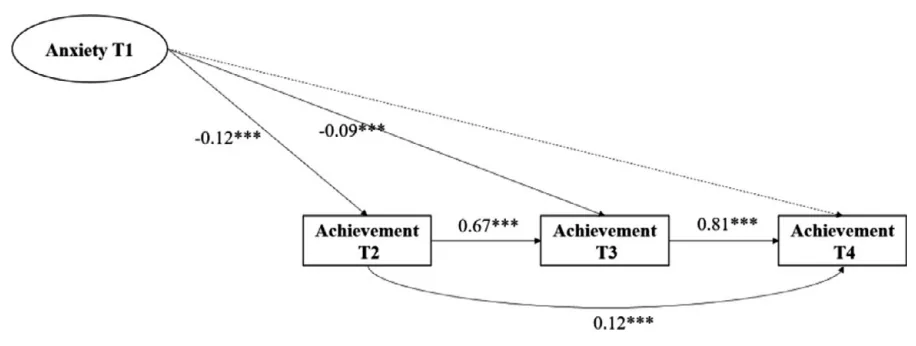
Figure 1. The predictive roles of anxiety at T1 on foreign language achievements at T2–T4.
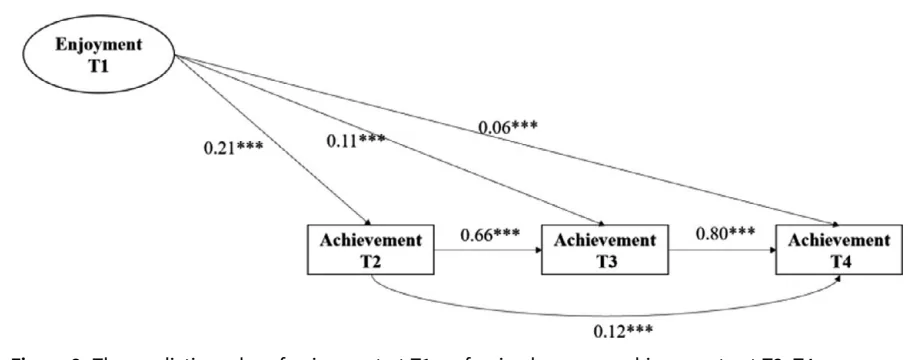
Figure 2. The predictive roles of enjoyment at T1 on foreign language achievements at T2–T4.
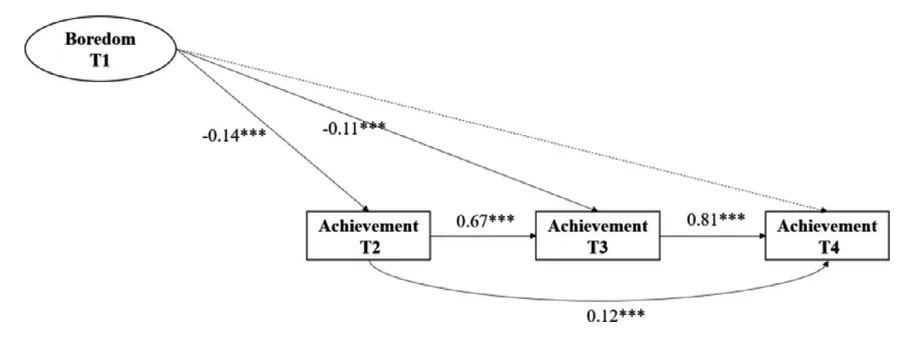
Figure 3. The predictive roles of boredom at T1 on foreign language achievements at T2–T4.
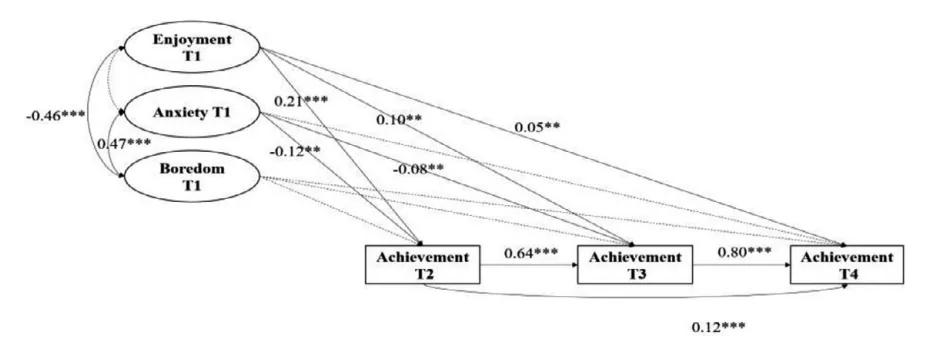
Figure 4. The joint predictive roles of enjoyment, anxiety, and boredom at T1 on foreign language achievements at T2–T4.
were both statistically significant. The path from boredom at T1 to FL achievement at T4 was not statistically significant.
The Joint Predictive Effects of Anxiety, Enjoyment, and Boredom on Subsequent Achievements
Figure 4 presents the model featuring how the three emotions (T1) were combined to predict FL achievements over time (T2–T4). The model demonstrates an acceptable fit to the data, χ 2 (df) = 951.80 (200), CFI = .95, TLI = .94, RMSEA = .06. Enjoyment was negatively related to boredom with a medium effect size (β = –.46, p < .001) and boredom was positively related to anxiety with a medium effect size (β = –.46, p < .001). By contrast, no significant correlation was found between enjoyment and anxiety when the three emotions were combined. Regarding their predictive effects, the paths from enjoyment at T1 to FL achievement at T2 (β=.21, p < .001) and from anxiety at T1 to FL achievement at T2 (β=–.12, p < .01) were both statistically significant, whereas the path from boredom at T1 to FL achievement at T2 was not statistically significant. The paths from enjoyment at T1 to FL achievement at T3 (β = .10, p < .01) and from anxiety at T1 to FL achievement at T3 (β = –.08, p < .01) were both statistically significant, whereas the path from boredom at T1 to FL achievement at T3 was not statistically significant. The path from enjoyment at T1 to FL achievement at T4 (β = .05, p < .01) was statistically significant, whereas the paths from anxiety and boredom at T1 to FL achievement at T4 were neither statistically significant.
Discussion
The current study aimed to examine how the three key achievement emotions, that is, FLE, FLCA, and FLLB, predict subsequent FL achievements at three different time points independently and jointly. The first hypothesis that the three emotions would be related to subsequent FL achievements independently was supported and enriched. As shown in Figures 1–3, higher FLE, lower FLCA, and lower FLLB at T1 predicted higher subsequent FL achievements at T2 (a week after T1) and T3 (five weeks after T1). However, for FL achievement at T4 (nine weeks after T1), FLE was the only significant predictor. This indicates that FLE had the longest independent predictive effect on subsequent FL achievements and the predictive effect could last at least for two months, while FLCA and FLLB predicted subsequent FL achievement one month later, but not subsequent FL achievement two months later. Our findings partially confirm the body of prior work in SLA and in general education (Dewaele et al., 2018; Li, 2020; Raccanello et al., 2019). More importantly and excitingly, our findings offer a crucial addition to the control-value theory (Pekrun, 2006), that is, the potential existence of a "time limit" on the connections between achievement emotions and subsequent academic achievements.
Our second hypothesis that the three emotions will be significantly related to each other was partially supported. As shown in Figure 4, inconsistent with prior work (Li et al., 2020), when entered into the same regression model as copredictors for FL achievements with the addition of boredom, higher enjoyment predicted lower boredom, higher anxiety predicted higher boredom, while no significant correlation was found between enjoyment and anxiety. This suggests that the presence of enjoyment does not necessarily mean the absence of anxiety. Instead, according to the threedimensional taxonomy of the control-value theory, these emotions are multidimensional rather than being situated along a single dimension reflecting positivity/negativity. More specifically, anxiety is a negative, activating, outcome-related achievement emotion, boredom is a negative, deactivating, process-related achievement emotion, while enjoyment is a positive activating process-related achievement emotion, pointing to the need for more empirical evidence for their connections rather than presumed positive or negative relationships between each two of them.
The third hypothesis that the three emotions will copredict subsequent FL achievements (T2–T4) (H3) was partially supported and extended with more complexities. As visualized in Figure 4, our findings are closer to the findings in a math domain while completely inconsistent with the findings in an L1 domain (Raccanello et al., 2019): Boredom lost its predictive effect on subsequent achievements when joint with enjoyment and anxiety, while enjoyment and anxiety copredicted subsequent FL achievements at T2 (a week after T1) and T3 (5 weeks after T1), but not T4 (9 weeks after T1). Similarly, for FL achievement at T4, enjoyment was the only significant predictor. The figure also suggests that compared to anxiety, boredom, although aversive, was less impairing in FL performance. This may explain why anxiety has enjoyed much more popularity than boredom in L2 research and why L2 boredom has been so inconspicuous and its research has just started. In line with two substudies in London and Saudi Arabia by Dewaele and Alfawzan (2018), our findings also show that the effect of enjoyment (T2: β = .21, p < .001; T3: β = .10, p < .01) outweighed that of anxiety (T3: β = –.12, p < .01; T3: β = –.08, p < .01). More importantly, our findings show that the predictive effect of enjoyment lasted longer (T4: β = .05, p < .01). Our findings suggest that enjoyment goes much beyond feeling well, instead, it has more profound and longlasting effects on subsequent achievements over time, compared to boredom and anxiety. However, it is surprising that the negative emotion, i.e., anxiety, has been much more intensively researched than the positive emotion, i.e., enjoyment. Our findings can serve as a wake-up call for L2 researchers to continue exploring the great potential of enjoyment, as well as other positive emotion, which ultimately may contribute to fostering learner well-being and L2 development.
There is already a substantial body of research examining how FLCA relates to FL achievement. However, the relations between FLE, FLLB, and FL achievement are relatively underexplored. Our study, to our best knowledge, is the very first to examine FLLB and its link with FL achievement. Our study is also the very first to connect the three representative emotions in the same study in the specific context of L2, probing into their independent and joint contributions to subsequent achievements at three different time points.
Most of extant L2 emotion studies have been conducted among samples of undergraduates in urban areas, relatively very few of them have attended to younger aged populations, especially students in junior secondary school settings and primary school settings in rural areas. Our study provides new evidence from younger aged populations in rural areas for the relations between these three emotions, and between them and subsequent FL achievements, supporting and extending the applicability of the controlvalue theory.
Prior studies tend to take a cross-sectional research design to examine the correlations between FLCA, FLE, and FL achievement. In the present study, based on the general assumption of the control-value theory that achievement emotions predict subsequent achievement, we collected data over four waves in a semester, with a span of about ten weeks. This may better capture the dynamicity as assumed by the theory.
Implications, Limitations, and Suggestions for Future Research
Our findings provide implications for L2 teachers, teacher educators, and researchers. FLE, FLCA, and FLLB all had independent significant predictive effects on subsequent FL gains. This indicates that interventions to boost FLE, alleviate FLCA, and avert FLLB should contribute to FL gains over time to an extent. When joint together, in comparison to FLCA and FLLB, FLE had the largest and most enduring predictive effect on subsequent FL achievements at all time points. This suggests that FL teachers still need to attend to students' negative emotions (salient FLCA and inconspicuous but aversive FLLB), but do not need to be overanxious about them because positive effects of positive emotions like FLE may function like buffers against the negative effects of these negative emotions. Thus, compared to focusing on devising ways and strategies to regulate students' FLCA or FLLB passively, it should be more important for FL teachers to optimize their curriculum planning, and make their lesson delivery a more enjoyable and interesting experience to students. This resonates with the positive psychology view: building on human strengths or fostering positive traits to promote competence rather than focusing passively on how to prevent from negative sides (Seligman, 1998). The research implication is also obvious: as positive psychologists in SLA argue (Dewaele & Li, 2020; MacIntyre & Gregersen, 2012), a more holistic view on diverse emotions especially positive emotions like FLE should be embraced in future research. Our call to enhance positive emotions also resonates with the Double Reduction Policy released in China in July 2021, which aims to relieve the learning stress and pressure of formal instruction and assessment on schoolchildren and foster their emotional well-being.
The study has evidenced the relations between three key achievement emotions and subsequent achievements in the specific domain of EFL, supporting and extending the control-value theory in young learners in rural China, and providing some implications. However, there are some limitations to highlight. Firstly, although this panel design for the predictive effect investigation allowed for the control of autoregressive effects, and we also controlled the effects of the covariates including age, gender, and SES, this still does not suffice to establish causality. In other words, there may exist other variables that were not controlled in the current study but made a difference in the models tested. In addition, other L2 populations with different levels of SES should be included in future research.
Secondly, our examination of the relations between achievement emotions and FL achievements was limited to FLE, FLCA, and FLLB. However, as reported by language learners in prior studies (MacIntyre et al., 2019), a variety of other emotions arise in L2 contexts, positive (e.g., pride) and negative (e.g., guilt), activating (e.g., excitement and anger) and deactivating (e.g., relaxation, frustration, and hopelessness), activity-related and outcome-related (e.g., hope), as proposed in the three-dimension taxonomy of the control-value theory (Pekrun, 2006; Pekrun & Perry, 2014). In comparison to FLCA, and more recently FLE and FLLB, these emotions remain largely underexplored. Future research should extend to include them.
Thirdly, the three emotions under discussion are largely limited to the emotional experiences within the classroom as reflected in the items of the three emotion scales used in the current study, especially the items in the Foreign Language Classroom Anxiety Scale (Horwitz et al., 1986). For the Foreign Language Learning Boredom Scale(Li et al., 2021a), although homework-related boredom is addressed, other extracurricular boredom experiences are neglected in the scale. Future research should include out-of-class English learning activities as an important arena for diverse emotional experiences (Kruk, 2022; Kruk & Pawlak, 2022; Li, 2021b) because we are in a digital era where technologyenhanced mobile learning has become increasingly popular especially during the COVID-19 time and in the post-COVID-19 time. The methodological implication is also obvious: We need psychometrically sound measures that take into account outof-class emotional experiences.
Fourthly, the three emotions measured at one time point may not be reliable enough to predict FL achievements at later time points. Future research could include repeated measures of emotions at different time points if there were no similar restrictions as we had imposed by the participating school.
Fifthly, due to practical and logistical constraints, our findings were limited to the unidirectional relations from achievement emotions to FL achievements. No evidence was provided for the potential reciprocal links between them over time as proposed by the control-value theory. Future research could include more measurement of achievement and achievement emotions to assess their reciprocal relations going beyond this limitation.
Lastly, our findings were limited to the direct links between achievement emotions and FL achievements. As posited by the control-value theory, achievement emotions could influence achievement indirectly via various cognitive mechanisms and motivational mechanisms. Future research could include these mediating variables or mechanisms to allow for more nuanced understanding of their links.
Acknowledgments. The authors wish to thank the participants of the study. Sincere thanks also go to the anonymous reviewers and editors of SSLA for their helpful and constructive comments. The authors are solely responsible for any limitations and errors. The study is based on the project "The effect of learning environment on English learning behavior of left-behind children from rural areas in China: Examining the underlying psychological mechanisms (学习环境对农村留守儿童英语学习行为的影响及其心理机 制研究)", funded by the National Social Science Foundation of China (Grant No.: 19CYY017).
References
-
Alpert, R., & Haber, R. N. (1960). Anxiety in academic achievement situations. The Journal of Abnormal and Social Psychology, 61, 207–215.
-
Botes, E., Dewaele, J.-M., & Greiff, S. (2020). The foreign language classroom anxiety scale and academic achievement: An overview of the prevailing literature and a meta-analysis. Journal for the Psychology of Language Learning, 2, 26–56.
-
Curran, P. J., West, S. G., & Finch, J. F. (1996). The robustness of test statistics to nonnormality and specification error in confirmatory factor analysis. Psychological Methods, 1, 16–29.
-
Derakhshan, A., Kruk, M., Mehdizadeh, M., & Pawlak, M. (2021). Boredom in online classes in the Iranian EFL context: Sources and solutions. System, 101, 102556. https://doi.org/10.1016/j.system.2021.102556
-
Dewaele, J.-M., & Alfawzan, M. (2018). Does the effect of enjoyment outweigh that of anxiety in foreign language performance? Studies in Second Language Learning and Teaching, 8, 21–45.
-
Dewaele, J.-M., & Li, C. (2020). Emotions in second language acquisition: A critical review and research agenda. Foreign Language World, 196, 34–49.
-
Dewaele, J.-M., & Li, C. (2021). Students' perceptions of teacher enthusiasm and their L2 classroom engagement: The mediating effects of student enjoyment and boredom. Language Teaching Research, 25, 922–945.
-
Dewaele, J.-M., & MacIntyre, P. D. (2014). The two faces of Janus? Anxiety and enjoyment in the foreign language classroom. Studies in Second Language Learning and Teaching, 2, 237–274.
-
Dewaele, J.-M., Magdalena, A. F., & Saito, K. (2019). The effect of perception of teacher characteristics on Spanish EFL learners' anxiety and enjoyment. The Modern Language Journal, 103, 1–16.
-
Dewaele, J.-M., Witney, J., Saito, K., & Dewaele, L. (2018). Foreign language enjoyment and anxiety: The effect of teacher and learner variables. Language Teaching Research, 22, 676–697.
-
Fredrickson, B. L. (2003). The value of positive emotions: The emerging science of positive psychology is coming to understand why it's good to feel good. American Scientist, 91, 330–335.
-
Goetz, T., & Hall, N. C. (2014). Academic boredom. In R. Pekrun & L. Linnenbrink-Garcia (Eds.), International Handbook of Emotions in Education (pp. 321–340). Routledge/Taylor & Francis Group.
-
Horwitz, E. K. (2017). On the misreading of Horwitz, Horwitz, and Cope (1986) and the need to balance anxiety research and the experiences of anxious language learners. In C. Gkonou, M. Daubney, & J.-M. Dewaele (Eds.), New Insights into Language Anxiety: Theory, Research and Educational Implications (pp. 31–47). Multilingual Matters.
-
Horwitz, E. K., Horwitz, M. B., & Cope, J. (1986). Foreign language classroom anxiety. The Modern Language Journal, 70, 125–132.
-
Kline, R. B. (2010). Principles and practices of structural equation modeling (3rd ed.). Guilford.
-
Kruk, M. (2022). Dynamicity of perceived willingness to communicate, motivation, boredom and anxiety in second life: The case of two advanced learners of English. Computer Assisted Language Learning, 35, 190–216. https://doi.org/10.1080/09588221.2019.1677722
-
Kruk, M., & Pawlak, M. (2022). Understanding emotions in English language learning in virtual worlds. Routledge.
-
Li, C. (2020). A positive psychology perspective on Chinese EFL students' trait emotional intelligence, foreign language enjoyment and EFL learning achievement. Journal of Multilingual and Multicultural Development, 41, 246–263.
-
Li, C. (2021a). A control-value theory approach to boredom in English class among university students in China. The Modern Language Journal, 105, 317–334.
-
Li, C. (2021b). Looking back and looking forward: SLA research from a positive psychology perspective over the past decade (2012–2022). Foreign Language Education, 42, 57–63.
-
Li, C., & Dewaele, J.-M. (2020). The predictive effects of trait emotional intelligence and online learning achievement perceptions on foreign language class boredom among Chinese university students. Foreign Languages and Their Teaching, 5, 33–44.
-
Li, C., Dewaele, J.-M., & Hu, Y. (2021a). Foreign language learning boredom: Conceptualization and measurement. Applied Linguistics Review. Advance online publication. https://doi.org/10.1515/applirev-2020-0124
-
Li, C., Dewaele, J.-M., & Jiang, G. (2020). The complex relationship between classroom emotions and EFL achievement in China. Applied Linguistics Review, 11, 485–510.
-
Li, C., Huang, J., & Li, B. (2021b). The predictive effects of classroom environment and trait emotional intelligence on foreign language enjoyment and anxiety. System, 96, 1–11.
-
Li, C., Jiang, G., & Dewaele, J.-M. (2018). Understanding Chinese high school students' foreign language enjoyment: Validation of the Chinese version of the Foreign Language Enjoyment scale. System, 76, 183–196.
-
MacIntyre, P. D. (2017). An overview of language anxiety research and trends in its development. In C. Gkonou, M. Daubney, & J.-M. Dewaele (Eds.), New insights into language anxiety: Theory, research and educational implications (pp. 11–30). Multilingual Matters.
-
MacIntyre, P. D., Dewaele, J.-M., Macmillan, N., & Li, C. (2019). The emotional underpinnings of Gardner's Attitudes and Motivation Test Battery. In P. D. MacIntyre & A. Al-Hoorie (Eds.), Contemporary language motivation theory: 60 years since Gardner and Lambert (1959). (pp. 57–79). Multilingual Matters.
-
MacIntyre, P. D., & Gregersen, T. (2012). Emotions that facilitate language learning: The positive-broadening power of the imagination. Studies in Second Language Learning and Teaching, 2, 193–213.
-
Pawlak, M., Kruk, M., & Zawodniak, J. (2020a). Investigating individual trajectories in experiencing boredom in the language classroom: The case of 11 Polish students of English. Language Teaching Research, 1362168820914004.
-
Pawlak, M., Kruk, M., Zawodniak, J., & Pasikowski, S. (2020b). Investigating factors responsible for boredom in English classes: The case of advanced learners. System, 91, 1–10.
-
Pekrun, R. (2006). The control-value theory of achievement emotions: Assumptions, corollaries, and implications for educational research and practice. Educational Psychology Review, 18, 315–341.
-
Pekrun, R., & Perry, R. P. (2014). Control-value theory of achievement emotions. In R. Pekrun & L. Linnenbrink-Garcia (Eds.), International handbook of emotions in education (pp. 130–151). Routledge/ Taylor & Francis Group.
-
Plonsky, L., & Oswald, F. L. (2014). How big is "big"? Interpreting effect sizes in L2 research. Language Learning, 64, 878–912.
-
Putwain, D. W., Becker, S., Symes, W., & Pekrun, R. (2018). Reciprocal relations between students' academic enjoyment, boredom, and achievement over time. Learning and Instruction, 54, 73–81.
-
Raccanello, D., Brondino, M., Moè, A., Stupnisky, R., & Lichtenfeld, S. (2019). Enjoyment, boredom, anxiety in elementary schools in two domains: Relations with achievement. Journal of Experimental Education, 87, 449–469.
-
Scovel, T. (1978). The effect of affect on foreign language learning: A review of the anxiety research. Language Learning, 28, 129–142.
-
Seligman, M. E. P. (1998). Building human strength: Psychology's forgotten mission. APA Monitor, 29, 2. Teimouri, Y., Goetze, J., & Plonsky, L. (2019). Second language anxiety and achievement: A meta-analysis. Studies in Second Language Acquisition, 41, 363–387.
-
Tze, V. M. C., Daniels, L. M., & Klassen, R. M. (2016). Evaluating the relationship between boredom and academic outcomes: A meta-analysis. Educational Psychology Review, 28, 119–144.
-
Westphal, A., Kretschmann, J., Gronostaj, A., & Vock, M. (2018). More enjoyment, less anxiety and boredom: How achievement emotions relate to academic self-concept and teachers' diagnostic skills. Learning and Individual Differences, 62, 108–117.
-
Zhang, X. (2019). Foreign language anxiety and foreign language performance: A meta-analysis. The Modern Language Journal, 103, 763–781.
-
Zhang, X., Hu, B. Y., Ren, L., & Zhang, L. (2019). Family socioeconomic status and Chinese children's early academic development: Examining child-level mechanisms. Contemporary Educational Psychology, 59, 101792. https://doi.org/10.1016/j.cedpsych.2019.101792
Cite this article: Li, C. and Wei, L. (2023). Anxiety, enjoyment, and boredom in language learning amongst junior secondary students in rural China: How do they contribute to L2 achievement? Studies in Second Language Acquisition, 45, 93–108. https://doi.org/10.1017/S0272263122000031